
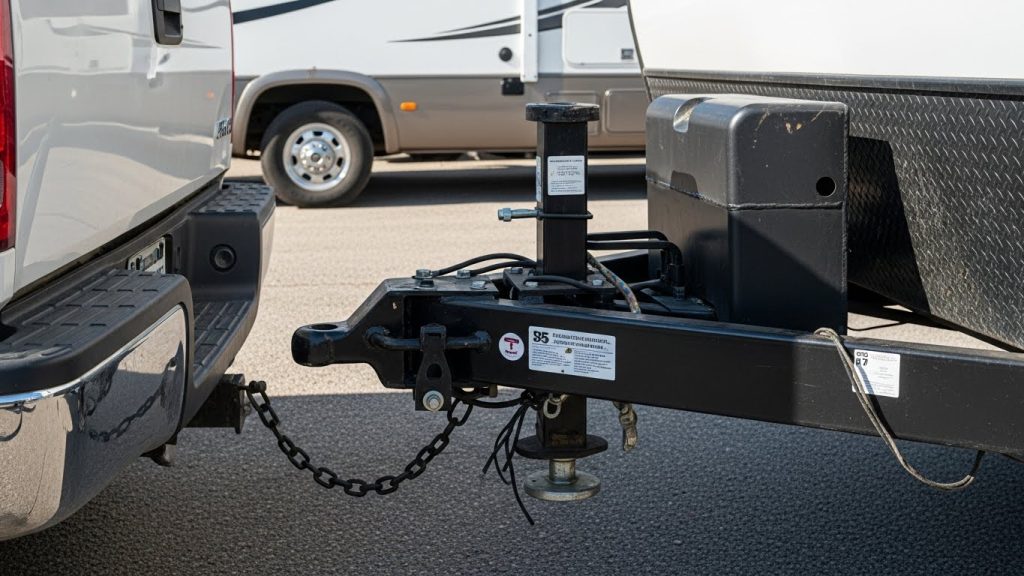
You’ll find fifth wheel hitches come in fixed, sliding, and pivot head designs tailored to your truck bed and towing needs.
Look for features like dual locking jaws for kingpin security, durable forged steel construction, and appropriate weight capacity, typically 15,000 to 30,000 lbs GTW.
Installation requires matching mounts and proper tools to guarantee safety and fit. Exploring further will provide deeper insight into making the right choice.
Key Takeaways
- Sliding hitches improve maneuverability for short-bed trucks, with options for manual or automatic adjustments enhancing turning radius.
- Dual jaw locking mechanisms provide superior kingpin security, reducing chucking and improving ride stability during acceleration and braking.
- High-quality hitches use forged steel and heat-treated components for durability, supporting gross trailer weights from 15,000 to 36,000 lbs.
- Popular models include B&W RVK3300, Curt Q24, and Andersen 3220, offering varied capacities and features to suit different towing needs.
- Proper installation requires compatible mounting systems, precise measurements, and safety gear to ensure secure, reliable hitch attachment.
Types of Fifth Wheel Hitches
When choosing a fifth wheel hitch, understanding the types available is essential to match your truck and towing needs.
Fixed hitches suit long-bed trucks, offering lighter weight and a stable, permanent connection. However, they limit maneuverability in tight spaces.
Sliding hitches, designed for short-bed trucks, improve turning radius by allowing hitch movement. Manual sliders need physical adjustment, while automatic ones engage electronically. These options add weight and complexity.
Pivot head hitches enhance ride smoothness with 2-way or 4-way pivoting but may require more maintenance. The choice between locking jaws also impacts ride quality and security, with options like single, double, or interlocking jaws providing varying levels of king pin contact.
Jaw types vary between single jaw, which offers fewer parts and strength, and double jaw, preferred for heavy loads with smoother locking.
Mounting options include universal rails, custom rails, factory puck systems, and above- or below-bed installations, depending on compatibility.
Key Features and Performance Benefits
Choosing the right fifth wheel hitch type lays the foundation for optimized towing performance by addressing specific truck and trailer dynamics.
These hitches improve weight distribution across axles, enhancing stability and reducing steer tire stress. One major advantage is their low noise operation, which enhances comfort during long trips.
Enhancing stability and easing steer tire wear through balanced axle weight distribution.
Dual jaw systems secure the kingpin fully, minimizing fifth wheel chucking during acceleration and braking.
Sliding models increase maneuverability, allowing you to navigate tight spaces with less trailer-to-cab contact and adjust hitch position for varying loads.
Premium hitches feature shock-absorbing components and pivoting heads, reducing road vibrations and noise for a smoother ride.
Additionally, sliding hitches optimize trailer positioning, lowering aerodynamic drag and boosting fuel efficiency.
Installation is straightforward, involving bolting rails to the truck bed, with removable options preserving bed space when not in use.
Weight Capacity and Build Quality Considerations
Because towing safety and performance rely heavily on the hitch’s weight capacity and build quality, you need to carefully assess these factors before selecting a fifth wheel trailer hitch.
Check that the gross trailer weight (GTW) and tongue weight capacities align with your trailer and truck specifications. It is essential to choose a hitch size that matches the trailer’s coupler to ensure a secure attachment. Quality materials like forged steel and heat-treated components ensure durability and resistance to wear.
Additionally, understanding the weight capacity in relation to your RV’s power system can help optimize overall safety. Features such as dual jaws and pivoting heads improve secure engagement and maneuverability.
| Factor | Typical Range | Key Feature |
|---|---|---|
| Gross Trailer Weight | 15,000 – 25,000 lbs | Manufacturer rating compliance |
| Tongue Weight | 3,000 – 6,000 lbs | Critical for safe load transfer |
| Materials | Forged steel, aluminum | Corrosion-resistant powder coat |
| Structural Design | Dual jaws, pivoting head | Enhanced articulation & security |
Installation Options and Compatibility
Evaluating the weight capacity and build quality of a fifth wheel hitch sets the stage for understanding the installation requirements and compatibility factors that follow.
When installing, you’ll need tools like a torque wrench, drill, ratchet set, and wire brush to prepare mounting brackets and base rails properly. Additionally, wearing safety glasses and work gloves is essential for protecting yourself during the installation process.
Compatibility hinges on matching hitch mounts to your trailer coupler and truck receiver, ensuring correct height and clearance.
Follow these key points:
- Precisely measure and mark drilling locations; use a center punch to avoid drill wandering.
- Remove the spare tire for better access during bracket installation.
- Use bolts with washers and adhere strictly to manufacturer torque specs for safety and stability.
- Verify fitment with your truck model and wiring harness compatibility before purchase.
Recommended Brands and Models

When selecting a fifth wheel hitch, you want to focus on brands and models that combine robust engineering with proven performance.
B&W hitches stand out for their durable construction, quiet operation, and secure locking mechanisms. Models like the RVK3300 offer a 20,000 lb capacity and a user-friendly two-piece design. The RVK3300 also features a double jaw with visual confirmation of jaw closure, ensuring a secure connection and quiet towing.
Curt’s Q24 model impresses with a 24,000 lb capacity and dual jaws ensuring 360-degree kingpin contact, minimizing chucking.
For heavy-duty needs, Curt PowerRide 30K supports 30,000 lbs.
Andersen and Reese provide reliable alternatives. Andersen’s 3220 Aluminum Ultimate excels in lightweight durability, while Tulga’s T10 delivers the highest 36,000 lb capacity at just 120 lbs.
These options balance load capacity, ease of installation, and durability for various towing demands.
Frequently Asked Questions
How Often Should I Inspect and Maintain My Fifth Wheel Hitch?
You should inspect your fifth wheel hitch every 6 months or 60,000 miles for visible damage and wear.
Heavy-duty users need a thorough check every 90 days or 750 hours.
Lubricate the locking mechanism every 3 months or 30,000 miles, and clean contact surfaces before major trips.
Always check hardware tightness and torque semi-annually and perform operational safety tests regularly to guarantee secure coupling and smooth function.
What Safety Tips Should I Follow When Towing With a Fifth Wheel Hitch?
A stitch in time saves nine, so always double-check your hitch before towing.
Make certain the kingpin is fully engaged and locked, then insert the safety pin to prevent disconnection.
Confirm the tailgate is down and inspect all lights, breakaway cables, and trailer jacks.
Grease the hitch plate regularly for smooth operation.
Drive cautiously, avoid sudden maneuvers, and maintain a safe following distance, especially on rough or uneven roads.
Can I Use a Fifth Wheel Hitch on a Short Bed Truck Without a Slider?
Yes, you can use a fifth wheel hitch on a short bed truck without a slider if you guarantee sufficient clearance.
Measure from the hitch center to your cab and subtract half the trailer’s front width. This gap should be at least 4 inches to prevent cab contact during turns.
Sidewinder hitches, which extend the kingpin forward, often provide this clearance without needing a slider.
Always verify your truck and trailer dimensions before deciding.
How Do Weather Conditions Affect Fifth Wheel Hitch Performance?
Imagine your fifth wheel hitch stiffening like frozen gears in a winter chill. Cold weather thickens grease, causing binding and reduced movement.
Moisture from snow and ice promotes rust, while road salt accelerates corrosion.
Heat and humidity expand metal parts and worsen wear, risking cracks.
To keep your hitch reliable, regularly clean, lubricate, and inspect it, especially after harsh weather, ensuring smooth, safe towing year-round.
Are There Special Insurance Requirements for Towing With a Fifth Wheel Hitch?
You don’t typically need special insurance just for towing with a fifth wheel hitch, but you must have liability coverage on your tow vehicle.
Some states, like Michigan, require trailer insurance if it has more than two wheels.
If you finance the trailer, lenders often demand extensive and collision coverage.
For commercial use, specialized insurance applies.
Standard auto policies usually exclude damage to the trailer itself, so you should consider separate or additional coverage.
From Reviews to the Road: Selecting a Reliable 5th Wheel Trailer Hitch
Choosing the right fifth wheel hitch isn’t just important; it’s like finding the backbone of your entire towing setup.
You’ll want to focus on weight capacity, build quality, and compatibility with your truck to ensure maximum safety and performance.
Whether you prefer a fixed or sliding hitch, understanding these technical details will save you headaches down the road.
With trusted brands and proper installation, your towing experience will be smoother and more reliable than you ever imagined.