To adjust self-adjusting trailer brakes, first jack up the trailer and remove the wheel. Locate the backing plate access plug, then use a brake spoon or similar tool to turn the starwheel adjuster until the brake shoes just contact the drum without dragging.
The self-adjusting cable and lever should maintain proper clearance during stops. If binding or corrosion occurs, manual adjustment is necessary. Keep the mechanism lubricated and clean for smooth operation. Continued guidance will help you maintain peak braking performance.
Key Takeaways
- The self-adjusting mechanism activates during forward stops to maintain proper shoe-to-drum clearance automatically.
- Manually adjust brakes using the starwheel adjuster accessed through the backing plate plug if automatic adjustment fails.
- Use a brake spoon or gearwrench tool to turn the starwheel and expand brake shoes outward for correct clearance.
- Inspect and lubricate the cable, lever, and pivot points regularly to ensure smooth self-adjusting operation.
- Perform a controlled break-in with gradual stops at 20 mph to seat brake shoes evenly after adjustment or installation.
How Self-Adjusting Trailer Brakes Maintain Proper Clearance?
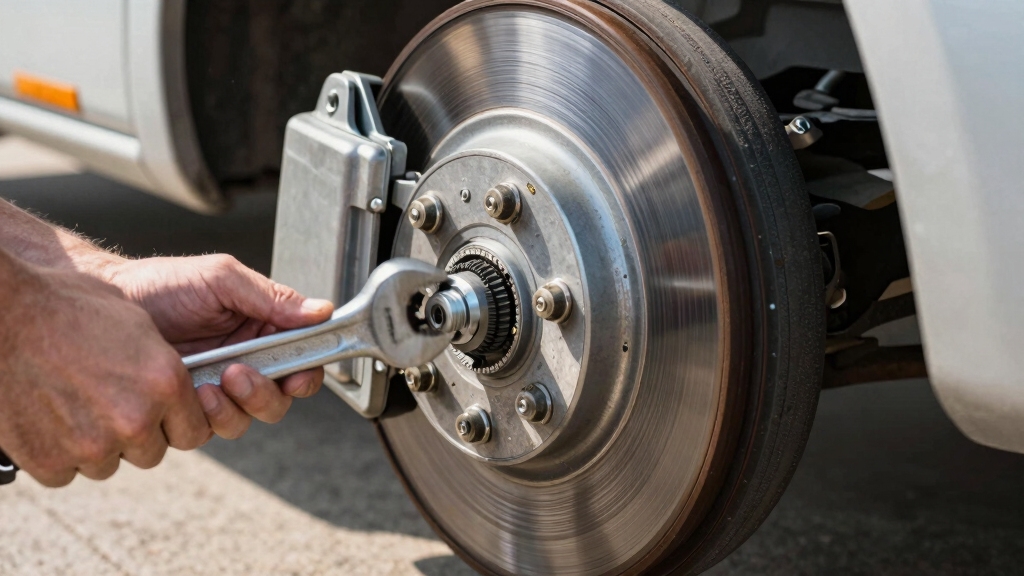
When you apply the brakes during a forward stop, the self-adjusting mechanism activates to maintain the correct shoe-to-drum clearance automatically.
A cable attaches to the front brake shoe, looping around a pulley on the rear shoe. As braking force engages, a lever rotates the adjuster, pushing the shoe outward.
This forward-adjusting action keeps the gap consistent and prevents dragging. The mechanism only adjusts upward to the stopping point, avoiding over-adjustment when maintained properly.
This system compensates for shoe wear without manual input, guaranteeing reliable, consistent braking performance.
You must make certain the components remain clean and free of corrosion for peak operation.
Failure to maintain the mechanism can result in improper clearance, reducing braking efficiency and increasing wear.
Regular maintenance, including inspection and lubrication, ensures the self-adjusting brake system functions smoothly and extends component life, similar to how trailer bearing maintenance improves durability.
Installing Brake Drums on Your Trailer Axle
Slide the brake drum carefully onto the spindle immediately after installing the inner bearing to guarantee proper fit and alignment.
Next, install the outer bearing followed by the flat washer and castle nut. Tighten the castle nut to approximately 50 lb-ft while rotating the drum to seat the bearings correctly.
Then, loosen the castle nut slightly and retighten it finger-tight to make certain the drum spins freely without excessive play. Align the castle nut slots with the spindle hole and insert the cotter pin to secure the assembly.
If necessary, slightly loosen the nut to align the tabs. Finally, reinstall the wheel and torque the lug nuts according to your trailer’s manual sequence to complete the brake drum installation.
For safety and ease during this process, using a jack with appropriate load capacity is highly recommended to properly lift and stabilize your trailer.
When to Manually Adjust Your Trailer Brakes?
Although the self-adjusting mechanism handles most brake shoe adjustments automatically during forward stops, you’ll need to manually adjust your trailer brakes if the automatic system fails to maintain the proper shoe-to-drum clearance.
This can occur if the internal cable binding, corrosion, or improper assembly prevents the adjuster lever from rotating the starwheel. Also, after extended brake shoe wear or during initial break-in, the automatic system mightn’t fully compensate.
You should check for excessive pedal travel, reduced braking efficiency, or uneven braking that signal adjustment is necessary. Use the access plug on the backing plate to reach the starwheel adjuster.
Turning the starwheel manually expands the shoes outward, restoring the correct gap and ensuring consistent brake engagement until the self-adjusting mechanism resumes proper function.
For optimal towing safety, it’s important to verify accurate brake adjustments regularly to prevent uneven wear and maintain braking performance.
Tools Needed to Adjust Self-Adjusting Trailer Brakes
Before adjusting your self-adjusting trailer brakes, you’ll need specific tools to reach and operate the starwheel mechanism through the backing plate access plug. These tools allow precise manual intervention when the automatic adjustment isn’t effective.
Using the correct tools guarantees safe and effective brake adjustment without disassembling the drum.
| Tool | Purpose |
|---|---|
| Brake spoon (Lisle) | Engage and turn the starwheel adjuster |
| Gearwrench brake tool | Alternative to brake spoon for access |
| Flathead screwdriver | Remove backing plate access plug |
| Flashlight | Illuminate the starwheel and adjuster area |
Having these tools ready streamlines the adjustment process and prevents damage to brake components. It is also important to ensure the trailer is properly supported with a jack of adequate capacity to maintain safety during brake adjustments.
Step-by-Step Manual Adjustment Guide for Trailer Brakes
To manually adjust your trailer brakes, start by locating the access plug on the brake backing plate and removing it with a flathead screwdriver.
Insert a brake spoon or starwheel tool into the opening to engage the adjuster mechanism. Rotate the starwheel upward to expand the brake shoes outward until they lightly contact the drum.
Use a brake spoon to turn the starwheel upward, expanding the brake shoes until they gently touch the drum.
After adjustment, rotate the drum by hand; it should turn with slight resistance without binding. If the drum is too tight, back off the adjuster slightly.
Reinstall the access plug securely to prevent debris entry. Repeat this procedure on all brake assemblies requiring adjustment.
Use this manual method only when the self-adjusting mechanism fails to maintain proper shoe-to-drum clearance. Always verify adjustments by a test stop to confirm consistent braking performance.
Ensuring your trailer uses tires with the correct load capacity is essential for maintaining safe and effective braking.
Maintaining the Self-Adjusting Mechanism for Optimal Performance
When you maintain the self-adjusting mechanism regularly, it guarantees your trailer brakes consistently compensate for shoe wear without over-adjusting.
Begin by inspecting the cable and lever assembly for corrosion, wear, or damage, ensuring smooth pulley rotation.
Lubricate pivot points with a high-temperature brake grease to prevent binding.
Confirm the adjuster wheel rotates freely when actuated by the lever during forward stops.
Check that the cable tension allows proper lever movement without slack.
Remove any accumulated debris from the backing plate and around the adjuster to avoid interference.
Verify the mechanism’s forward-adjusting action correctly pushes the shoes outward, maintaining the specified gap.
Performing these maintenance steps after routine brake inspections preserves peak self-adjusting function, ensuring consistent, reliable braking performance.
For enhanced towing safety and reduced noise, consider using anti-rattle hitch devices that stabilize your trailer connection during transit.
Troubleshooting Common Issues With Self-Adjusting Trailer Brakes
Maintaining the self-adjusting mechanism helps prevent many common issues, but if you notice inconsistent brake performance or abnormal wear, troubleshooting is necessary.
First, inspect the adjuster lever, cable, and pulley for damage or binding. Check shoe wear patterns and drum condition. If the mechanism sticks, manually adjust via the access plug to restore proper clearance.
| Issue | Possible Cause |
|---|---|
| Uneven shoe wear | Binding cable or lever |
| Brakes dragging | Over-adjusted or stuck adjuster |
| Insufficient braking force | Worn shoes or contaminated lining |
| No self-adjustment action | Broken or disconnected cable |
Address these promptly to guarantee safe, consistent braking and prevent costly repairs. For optimal towing safety and performance, ensure your trailer brake system is compatible with your vehicle’s load capacity requirements to avoid overload and maintain stability.
Tips for Breaking In and Maintaining Your Trailer Brakes
When you install your trailer brakes, it’s super important to follow a proper break-in procedure right away. This helps make sure that the shoe and drum are making the best contact possible.
And while you’re at it, don’t forget to regularly check on the self-adjusting mechanism. If you neglect it, you might run into issues like over-adjustment or even failure.
Keeping up with maintenance is key! Regular upkeep not only ensures your brakes are working reliably but also helps extend their service life.
Additionally, maintaining the correct tire load capacity is essential to avoid excessive strain on the braking system and ensure overall towing safety.
Break-In Procedure
Begin the break-in procedure by performing several controlled stops at moderate speeds to seat the brake shoes evenly against the drum surface. This guarantees uniform contact and prime friction for effective braking.
Avoid harsh stops initially to prevent uneven wear or glazing. Gradually increase braking force over multiple cycles. Monitor temperature and braking response closely.
| Step | Action | Purpose |
|---|---|---|
| 1 | Controlled stops at 20 mph | Seat shoes evenly |
| 2 | Gradual speed increase | Prevent glazing |
| 3 | Multiple brake applications | Achieve consistent friction |
| 4 | Inspect drum/shoes | Check for wear or damage |
| 5 | Confirm brake response | Verify proper shoe seating |
Following this break-in process maximizes brake performance and longevity. Ensuring corrosion resistance in brake components can further extend the durability and reliability of your trailer brakes.
Maintenance Best Practices
Regularly inspecting and properly breaking in your trailer brakes guarantees consistent performance and extends their lifespan.
Start by completing the recommended break-in period after installation, applying moderate braking to seat the shoes evenly.
Inspect the self-adjusting mechanism frequently, assuring the cable and lever move freely without corrosion or damage.
Clean the backing plate and lubricate pivot points with appropriate grease to prevent binding.
Check drum and shoe wear, replacing components when thickness falls below specs.
Use the manual adjuster only if the self-adjust feature fails, accessed via the plug on the backing plate.
Avoid over-tightening, which risks over-adjustment and brake drag.
Maintain mounting hardware and electrical connections to assure reliable operation.
Following these maintenance best practices keeps your trailer brakes functioning safely and efficiently.
Additionally, using non-toxic grease for lubricating pivot points ensures safety around pets and family while maintaining optimal brake function.
Frequently Asked Questions
Can Self-Adjusting Brakes Be Used on All Trailer Types?
You can’t use self-adjusting brakes on all trailer types. They’re compatible mainly with axles rated between 3,500 and 7,000 pounds, fitting specific bolt patterns and dimensions.
If your trailer axle matches these specs and brands like Dexter or AL-KO, you’re good to go. Otherwise, you’ll need different brakes.
Always verify axle ratings and brake size compatibility before installation to make certain safe, effective braking performance on your trailer.
How Often Should Brake Fluid Be Checked With Self-Adjusting Brakes?
Think of brake fluid like the lifeblood of your braking system. It needs regular attention.
You should check your brake fluid at least once every 3 to 6 months, or before any long tow.
Inspect it for proper level and clarity, ensuring no contamination. Even with self-adjusting brakes, maintaining fluid quality is critical; neglect can lead to brake failure.
Follow your trailer manual’s maintenance schedule for peak safety and performance.
Do Self-Adjusting Brakes Require Special Brake Shoes?
You don’t need special brake shoes for self-adjusting brakes, but you must use shoes compatible with the system’s specifications.
For example, 10-by-2.25-inch shoes fit 3,500 lb axles, while 12-by-2-inch shoes suit 4,000-7,000 lb axles.
Make sure the shoes match your axle rating and brake assembly brand like Dexter or AL-KO.
Using correct shoes guarantees the self-adjusting mechanism maintains proper clearance and consistent braking performance.
Are There Compatibility Concerns With Different Trailer Brands?
Yes, you need to verify compatibility between your trailer’s axle and the self-adjusting brake kit.
These brakes fit 3,500 lb axles with a 5-lug, 2-7/8” x 2-7/8” bolt pattern and 7,000 lb axles with 6 or 8 lugs, 12” diameter shoes.
They’re compatible with Dexter, Lippert, Rockwell American, Quality, and AL-KO brands.
Always confirm your axle specs match the kit’s to guarantee proper fit and function.
What Is the Lifespan of a Self-Adjusting Brake System?
You’ll find self-adjusting brake systems last anywhere from 30,000 to 70,000 miles, depending on use and maintenance.
While they automatically keep shoe clearance ideal, neglecting inspections or break-in periods can shorten lifespan drastically.
To maximize durability, regularly check components, guarantee proper lubrication, and avoid harsh stops.
Precision Braking Starts With Proper Adjustment
Adjusting your self-adjusting trailer brakes is like fine-tuning a precision instrument. Every click guarantees safety and performance. By following proper installation, manual checks, and maintaining the mechanism, you keep your brakes responsive and reliable.
Treat this process as you would calibrate a well-oiled machine: deliberate, precise, and consistent. With the right tools and know-how, your trailer will brake smoothly, protecting both your cargo and your journey every time you hit the road.