You can pull a boat behind your travel trailer, but you need to know state laws. Many eastern states ban recreational double towing, and some require permits. Check your trailer’s towing capacity and hitch ratings, ensuring proper load distribution and safety chains.
Equip electric brakes and lighting, and perform thorough pre-trip inspections for safe towing. Adjust your driving for stability and brake control. Following these steps will help you tow efficiently and legally; here’s what else you should consider to prepare fully.
Key Takeaways
- Many states allow towing a boat trailer behind a travel trailer but impose length, weight, and permit restrictions varying by jurisdiction.
- Ensure the combined trailer length and weight comply with state-specific limits, often around 60 to 75 feet total length.
- Use a properly rated hitch, weight distribution, and anti-sway system to maintain stability when towing two trailers.
- Confirm your vehicle and travel trailer’s towing capacities cover the combined weight of both trailers and their loads.
- Equip the boat trailer with safety chains, functional brakes, lighting, and perform regular maintenance before travel.
Understanding Legal Restrictions for Towing Multiple Trailers
Although towing multiple trailers can increase your hauling capacity, you must first understand the complex legal restrictions that vary widely by state. Many states also require safety chains and specific braking systems to enhance secure towing.
Most eastern coastal states, from Maine to Florida, ban recreational double towing except Maryland, which allows it. States like Washington, Oregon, and Hawaii also prohibit it.
Louisiana only permits one trailer at a time, while Virginia requires special permits. North Carolina limits double towing to National Network highways. Federal law requires allowance of twin-trailer commercial rigs on federal network highways under specified limits, but this does not apply to recreational towing.
Federal law allows twin-trailer commercial rigs on designated highways but doesn’t cover recreational towing. Length and weight limits differ, with some states capping combined trailer lengths between 60 and 75 feet.
Many states enforce weight rules, require brakes on heavier trailers, and mandate safety chains. Knowing these laws guarantees safe, legal towing when pulling a boat behind your travel trailer.
Assessing Your Travel Trailer’s Towing Capacity
Start by reviewing your travel trailer’s towing capacity through the manufacturer’s ratings and real-world measurements. Using a reliable tongue weight scale can help ensure accurate force measurements.
Check the Gross Vehicle Weight Rating (GVWR) on the door jamb or manual to establish payload limits. Confirm the Gross Combined Weight Rating (GCWR) to know your maximum safe towing load.
Use the Trailer Weight Rating (TWR) to avoid exceeding certified trailer weight. Calculate actual loads: add cargo, water, and gear to the trailer’s dry weight to find Gross Trailer Weight (GTW).
Measure tongue weight, ideally 10–15% of GTW, with a scale for accuracy. Note that tongue weight is the downward force exerted on the hitch ball and should be carefully managed. Remember, tongue weight reduces your vehicle’s payload capacity, so include it in calculations.
Essential Safety Equipment for Towing a Boat Behind a Travel Trailer
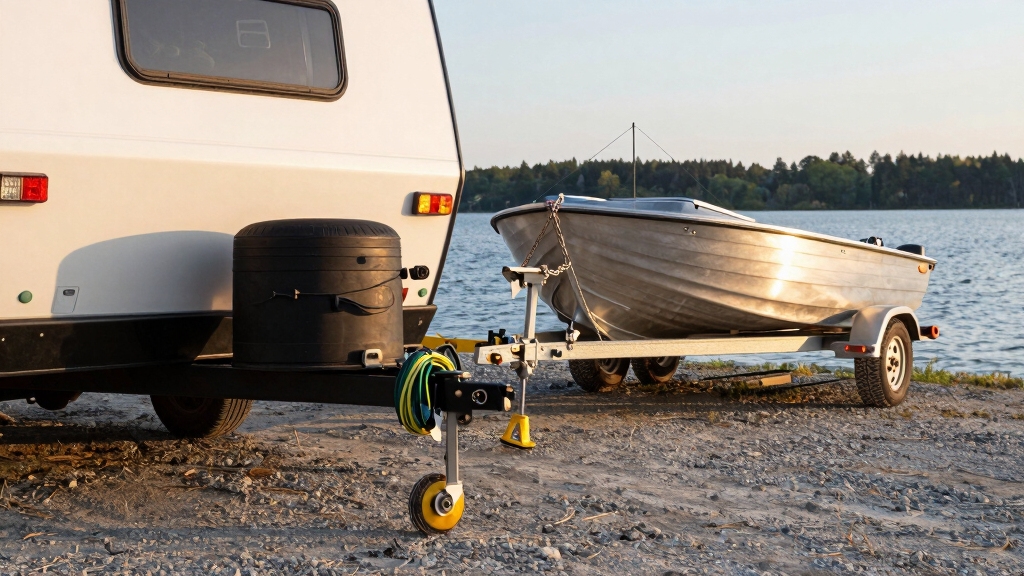
When towing a boat behind your travel trailer, you must equip both trailers with reliable safety gear to guarantee secure connections and control. Proper equipment assures your multi-trailer setup stays safe on the road.
Ensuring secure connections and control with reliable safety gear is crucial when towing a boat behind your travel trailer.
- Heavy-duty safety chains criss-crossed between trailers prevent separation if the hitch fails, combined with a secondary hitch lock to avoid accidental uncoupling. Using components that meet durability standards enhances overall safety in your towing setup.
- Functional electric brakes on both trailers with a breakaway actuator on the boat trailer automatically apply brakes if separation occurs. It is important to note that trailer brakes are often required by state law when the GVWR is 1,500 lb or more to ensure safe stopping power.
- Full-function lighting harness with sealed connectors assures all signals work properly; always test before departure. Proper maintenance and inspection of electrical connections prevent unexpected lighting failures on the road.
- Tire and suspension checks on the boat trailer, including correct tire pressure, spare tire, and inspected wheel bearings, prevent failures during travel. Regular inspection of tires for sidewall cracks or wear is critical since tire neglect is a common cause of trailer failure.
Importance of Proper Hitch and Anti-Sway Mechanisms
Because towing a boat behind your travel trailer adds extra length and weight, choosing the right hitch and anti-sway mechanisms becomes critical to maintaining control and safety on the road.
Match your hitch class to the combined Gross Trailer Weight (GTW) of both trailers, aiming for a hitch rated about 20% higher than expected loads. Make certain the tongue weight capacity also exceeds your setup’s needs to prevent sag and instability.
Install a weight-distribution system if rear sag or steering degradation occurs. It redistributes tongue load across vehicle axles, enhancing stability. Complement this with appropriate anti-sway devices, such as friction or weight-distribution-mounted sway controls, to reduce trailer oscillations caused by crosswinds or uneven loads.
Regularly verify all components’ ratings and adjust for any load changes to keep towing safe and stable. Consider using a weight distribution hitch with integrated sway control for improved stability and ease of installation.
Tips for Maneuvering With a Boat Trailer Attached

Maneuvering with a boat trailer hitched behind your travel trailer calls for careful adjustments to your driving habits. You need to adapt your speed, turning, and visibility strategies to make certain safety and control.
- Take wider, slower turns to prevent the boat from rubbing your RV and maintain extra clearance. Using a proportional brake controller can help improve braking stability when towing.
- When backing up, move slowly, use a spotter, and turn the steering wheel opposite the trailer’s direction. It is also helpful to keep windows down and sound system off while maneuvering to improve situational awareness.
- Reduce speed and increase following distance; brake gently and early to avoid trailer sway or fishtailing.
- Adjust your side mirrors for full trailer visibility and confirm all brake lights and signals function properly before moving.
Pre-Trip and On-the-Road Inspection Practices
Handling a boat trailer behind your travel trailer requires more than careful driving. It demands thorough inspections before and during your trip.
Before you hit the road, verify trailer lights, including brake and turn signals, are working and securely plugged in. Check that the hitch coupler is locked with safety chains and emergency breakaway cable attached.
Additionally, perform a full light check including tail, brake, blinker, and marker lights to ensure all are functioning properly. Ensuring your trailer tires have the correct load capacity can prevent blowouts and maintain safe handling.
Inspect tire pressure, sidewalls, tread, and torque lug nuts to specs. Make certain the winch and transom straps hold the boat firmly without rubbing the hull.
Fold down antennas, raise the outboard engine, and remove the drain plug. Remember to secure transom tie-down strap(s), tighten the winch, and engage the winch safety chain for added security.
On the road, stop every couple of hours for a walkaround to check straps, chains, and wheel hub temperature. Monthly, lubricate hubs, tighten lug nuts, and inspect brakes and frame for wear or corrosion. Check the trailer frame and axle condition for corrosion after saltwater use to maintain trailer integrity.
State-Specific Regulations for Double Towing
When you plan to tow both a travel trailer and a boat, you need to be aware that state laws vary widely on double towing.
Some East Coast states ban recreational double towing entirely, while others allow it with permits or on specific highways. Using a tire pressure monitoring system can enhance safety when towing multiple trailers.
Western states often have strict weight and hitch requirements. The Midwest and Southern states set limits on length and trailer type. Note that some states require each trailer to undergo separate safety inspections before being allowed on the road.
Here’s what you should keep in mind:
- Eastern coastal states mostly prohibit double towing; exceptions require permits or specific routes.
- Western states like California and Michigan enforce weight minimums and special hitch mandates.
- Midwest states limit combined length and restrict trailer types, often allowing boats or ATVs as second trailers.
- Southern states cap total length around 65 feet and regulate vehicle combinations closely.
Insurance and Licensing Considerations
Before you tow a boat behind your travel trailer, it’s really important to get a handle on the insurance coverage requirements and the licensing rules that vary by state.
You know, your auto policy usually takes care of liability for the trailer, but there might be a need for some endorsements or even separate coverage if you’re worried about physical damage. Boat trailer insurance typically does not exist as a separate policy but can be added to your boat insurance.
Additionally, ensuring proper insurance for RV accessories can help avoid uncovered claims. So, it’s a good idea to check in with your local regulations and have a chat with your insurance agent. This way, you can make sure you’re not leaving any gaps in protection or running into legal issues down the road.
Insurance Coverage Requirements
Although no state requires separate insurance specifically for boat trailers, you’ll need to understand how your existing policies cover towing.
Your auto insurance typically extends liability coverage to the trailer when it’s connected, but collision or exhaustive coverage may require you to list the trailer explicitly. Also consider environmental liability if you plan on using your boat and trailer frequently near water bodies.
Boat insurance can cover trailer damage if added, but it usually doesn’t include liability for towing incidents. Some boat insurance plans also offer customized trailer coverage as part of their tailored solutions.
Homeowners insurance might protect your trailer while stored at home but often excludes coverage at marinas. Consider these key points:
- Verify your auto policy’s trailer coverage and add if needed.
- Add trailer protection to your boat insurance for physical damage.
- Check homeowners insurance limits and exclusions for stored trailers.
- Always confirm coverage details with your insurer before towing.
Licensing and Endorsements
Since towing regulations depend heavily on trailer weight and type, you need to understand the specific licensing and endorsement requirements that apply to your situation. Using the correct load capacity jack can also ensure safe lifting and maintenance of your trailer.
If your trailer’s GVWR exceeds 10,000 pounds, you’ll need a special endorsement on your Class C license. For combined weights over 26,000 pounds, a commercial Class A or B license is mandatory.
Fifth-wheel trailers up to 15,000 pounds require a recreational endorsement. Ensure that your trailer’s brakes are properly installed and functional, as trailers over 1,500 pounds must have brakes on at least one axle.
| License Type | Trailer Weight Limit | Endorsement Required? |
|---|---|---|
| Class C | Up to 10,000 lbs | No |
| Class C + Endorsement | 10,001 to 15,000 lbs (5th wheel) | Yes (recreational) |
| Noncommercial Class A | Any under Class C limits | No |
| Commercial Class A/B | Over 26,000 lbs combined | Yes |
State-Specific Regulations
When towing a boat behind your travel trailer, you need to be aware of state-specific regulations that affect both insurance and licensing requirements.
Insurance mandates vary greatly; Arkansas and Utah require liability coverage for most motorboats, while Hawaii applies rules based on vessel size or facility use. In some states, insurance is only required if a lender or marina mandates it, so understanding these conditional requirements is essential state insurance conditions.
Additionally, your auto insurance typically covers liability when towing. However, physical damage to the trailer often needs separate coverage. Trailer registration is also vital, as many states require plates or registration for trailers above certain weights, impacting liability after incidents.
- Verify your state’s boat insurance laws and minimum liability limits.
- Confirm if your auto insurance covers trailer physical damage or if you need additional policies.
- Register your trailer per state requirements to avoid legal complications.
- Check if lenders or marinas mandate trailer insurance proof to comply with contracts.
Best Practices for Load Distribution and Trailer Maintenance
To make certain a safe and smooth tow, start by distributing your boat’s load evenly to prevent swaying and maintain stability. Begin your tow by evenly distributing your boat’s load to avoid swaying and ensure stability.
Arrange cargo across all sides and use a load-distributing hitch rated slightly above your hitch weight. Adjust spring bars so your tow vehicle remains level front to rear. Before hitting the road, verify your trailer sits level by measuring ground clearance and adjusting hitch tension accordingly.
Secure the hitch coupler and attach safety chains in a crisscross pattern under the hitch. Inflate your vehicle tires to the proper PSI to reduce risk of flats and provide a stable towing foundation. Regularly check tire pressure, grease bearings, and inspect brakes and lights.
Limit speed to your trailer tire’s maximum rating, leave extra braking distance, and perform frequent walk-around inspections. These steps maintain stability, enhance safety, and prolong your trailer’s lifespan during towing.
Frequently Asked Questions
Can I Use a Weight Distribution Hitch With a Boat Behind a Travel Trailer?
You can use a weight distribution hitch when towing a boat behind a travel trailer, but you need to be cautious. Make sure your WD hitch is rated for the combined weight and compatible with both trailers’ tongue designs.
Watch for braking systems since surge brakes on boat trailers often conflict with WD hitches. Always check your vehicle’s towing capacity, avoid over-tightening, and consider sway control for safer handling on the road.
How Does Towing a Boat Affect My Rv’s Fuel Efficiency?
Towing a boat markedly reduces your RV’s fuel efficiency, often by 30-50%.
If you’re pulling a lighter boat around 3,000 lbs, expect about 13 mpg with tow-haul mode engaged.
Heavier loads, like a 9,000 lbs boat plus gear, can drop mileage closer to 9 mpg.
Using a diesel engine helps offset these losses, especially with heavier boats, by improving fuel economy compared to gasoline setups.
What Are Common Signs of Trailer Sway to Watch For?
You’ll first notice your trailer moving side-to-side on its own, almost like it has a mind of its own. Check your mirrors; if you see oscillation around the hitch ball or the trailer swinging wider with each cycle, that’s a red flag.
You might feel a gentle rocking, your steering wheel pulling slightly. If the sway worsens, it can lead to fishtailing or even jackknifing, so stay alert and react quickly.
Are There Specific Boat Trailer Tire Recommendations for Long Trips?
Yes, you should choose radial ST tires like the Carlisle Radial Trail HD or Goodyear Endurance for long trips. These handle heat buildup and heavy loads well, keeping your boat trailer stable.
Opt for a tire size matching your rim and load requirements, preferably 215 width for better contact and load rating D or higher. Look for tires with deep tread and sidewall protection to ensure durability and traction on wet ramps.
Can I Camp Overnight With a Boat Hitched Behind My Travel Trailer?
About 30% of campgrounds have rules against leaving a boat hitched behind your travel trailer overnight. You can camp overnight with your boat hitched, but you need to check campground policies first.
Some sites restrict extra length or require unhitching for safety and space reasons. Always secure your boat properly, make certain legal compliance, and confirm your campground allows it to avoid fines or being asked to move.
Turn Every Mile into a Confident Voyage
Towing a boat behind your travel trailer is like steering two oars through one river. You need balance, control, and awareness. By understanding legal limits, ensuring proper equipment, and maintaining safety checks, you keep your journey smooth and secure.
Remember, each hitch and inspection is a ripple that prevents waves. Stay informed, follow regulations, and distribute your load wisely. Navigate the road confidently, turning your adventure into a seamless voyage.