You can run two RV air conditioners on a 30-amp service, but it’s challenging because their combined running amps often approach or exceed the safe continuous load (around 24 amps).
Startup surges can double current draw, which may lead to breaker trips. Using soft start kits reduces these surges by up to 70%, making dual AC operation more feasible.
Careful load management and staggered start times help prevent overloads. If you want reliable dual AC cooling on 30 amps, understanding these factors is critical.
Key Takeaways
- Running two RV AC units on a 30-amp service often exceeds the safe continuous load capacity, risking breaker trips.
- Startup surges for dual ACs can surpass 100 amps, causing immediate breaker trips without surge reduction measures.
- Soft start kits reduce startup current by up to 75%, enabling smoother dual AC startups within 30-amp limits.
- Avoid simultaneous compressor startups by staggering AC cycling times to minimize combined inrush current.
- Continuous dual AC operation on 30 amps is unreliable; prioritize load management and verify actual amperage before use.
Understanding RV AC Power Requirements
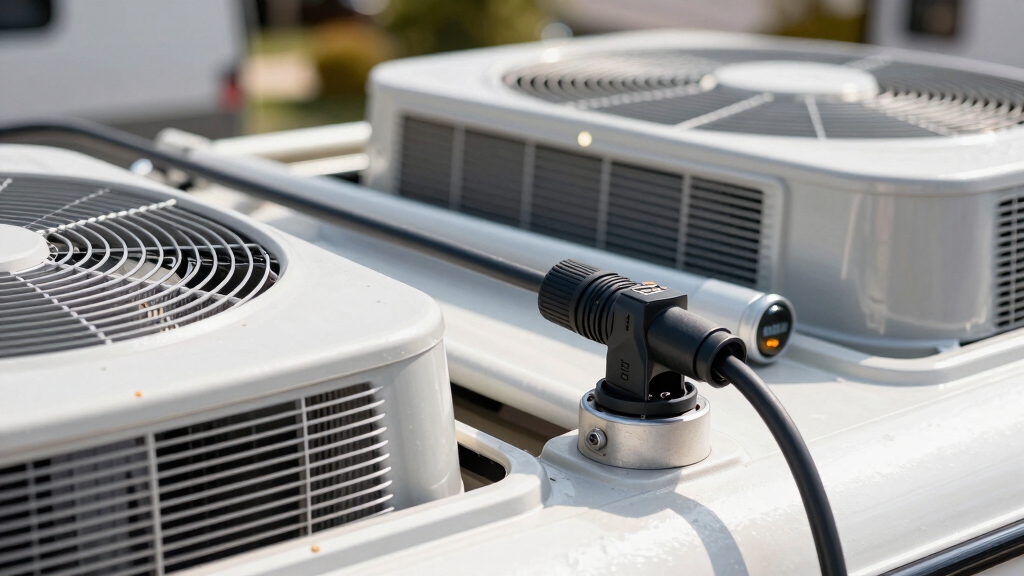
When you plan to run an RV air conditioner on a 30-amp circuit, you need to understand the specific power requirements involved.
Typical rooftop AC units rated 13,500–15,000 BTU draw about 12–16 amps continuously on a 120V supply, with startup surges spiking from 25 to 50 amps.
Since the 30-amp RV pedestal provides one 120V hot leg and continuous loads shouldn’t exceed 80% of the breaker rating (approximately 24 amps), managing startup surges and steady consumption is critical.
For every 1,000 BTU cooling output, about 100 W input is typically needed, which helps estimate power demands more accurately.
Running wattages range from 500 watts for 7,000 BTU units up to nearly 1,900 watts for 15,000 BTU models.
Factors like ambient temperature, unit efficiency, and maintenance impact power draw. Using an RV surge protector with a proper joule rating can help safeguard your electrical system from damage caused by surges.
Use manufacturer data and clamp meters to verify actual amps before integrating multiple AC units on a 30-amp circuit.
Limitations of 30 Amp Service for RV Appliances
Although a 30-amp RV service supplies up to 3,600 watts at 120 volts, this capacity quickly limits your ability to run multiple high-demand appliances simultaneously.
A 30-amp RV service provides 3,600 watts but limits simultaneous use of multiple high-demand appliances.
Each rooftop A/C unit alone can draw between 1,000 and 2,000 watts, so running two simultaneously risks tripping the shore power breaker.
Furthermore, branch circuits may remain under their individual breaker limits while collectively exceeding the 30-amp shore service capacity.
High inrush currents during compressor startups further increase trip risk. Continuous loads should be derated by 125% for safety, making prolonged dual-A/C operation on 30 amps unreliable.
Choosing a generator with sufficient power output can help manage these demands during off-grid camping.
To avoid nuisance trips, you must manage appliance scheduling, prioritize loads, and avoid resistive high-draw devices when running A/C. Overloading also stresses wiring and breakers, posing safety hazards and reducing system reliability.
A 30 amp service provides a single leg of 120V AC with common and safety ground, which inherently limits the total available current compared to 50 amp service 30 amp service.
Power Consumption of Single vs Dual RV AC Units

Managing power loads becomes more challenging as you consider running two RV air conditioners instead of one on a 30-amp service.
A single 13,500 BTU AC typically consumes 1000-1300 watts running, while two such units double the load to 2000-2600 watts. It’s important to note that energy efficiency ratings can significantly affect the actual power draw of each unit.
For 15,000 BTU models, one unit draws 1200-1700 watts, but dual units can reach 2400-3400 watts combined.
Since a 30-amp RV circuit provides roughly 3600 watts continuously, running dual units approaches or exceeds this limit, leaving little room for other appliances.
You’ll need to check the exact wattage from manufacturer specs, as efficiencies vary.
Also, consider daily energy usage, as two units running 12 hours can exceed 30 kWh, markedly increasing power demands beyond what 30 amps can support reliably.
Because starting watts are often significantly higher than running watts, the initial surge when both AC units start simultaneously can cause circuit breakers to trip or overload the system, which is an important factor to consider when planning your power usage for two units on a 30-amp circuit.
Startup Wattage and Its Impact on Circuit Breakers
Because RV air conditioners demand a significant surge of power at startup, often 2 to 3 times their running wattage, you’ll frequently encounter circuit breaker trips on a 30-amp service. Proper circuit protection is essential to prevent damage to your electrical system.
The startup inrush can reach 50-65 amps, well above the 30-amp breaker limit, causing immediate trips. This surge overloads the breaker’s thermal-magnetic mechanism despite its 80% continuous load rating.
Dual AC startups exacerbate this, pushing combined surges beyond 100 amps and damaging breakers over time. However, using a SoftStartUp controller can reduce startup inrush current by approximately 50%, enabling smoother startups within limited power constraints.
| AC Unit Size | Startup Watts | Startup Amps (Typical) |
|---|---|---|
| 13,500 BTU | 2,800 | 55 |
| 15,000 BTU | 3,500-4,000 | 60-65 |
| Dual Units | 6,300-7,800 | 100+ |
| Breaker Limit | N/A | 30 |
| Soft Start | Reduced by 70% | ~26 |
Strategies to Run Two AC Units on a 30 Amp System

If you want to run two AC units on a 30 amp system, there are a few things you can do to make it work smoothly.
First off, consider installing soft-start devices. These handy gadgets can help reduce the startup current of your AC compressors, which is super important because it keeps your breakers from tripping.
Now, managing your load is key. You might want to stagger the thermostat settings on your AC units. This way, they don’t kick on at the same time, which could push you over that 30 amp limit.
And don’t forget to think about any other electrical demands on the circuit. Keeping all of this in mind will help you stay within safe amperage limits while ensuring your AC units run reliably.
Installing a soft start device can reduce the compressor startup current by up to 75%, significantly easing the electrical load during startup.
Soft Start Implementation
Implementing soft-start technology lets you markedly reduce the startup surge current of each RV rooftop AC compressor, enabling two units to run more reliably on a 30-amp shore power connection.
Soft-start modules use controlled semiconductor switching to ramp voltage gradually, cutting inrush current by about 70%. This prevents breaker trips during compressor startup and can extend the lifespan of air conditioning units.
You should install a soft-start device on each compressor, following manufacturer wiring diagrams precisely and ensuring secure mounting. Hard-wired installations are recommended for running A/C off lithium batteries and offer a permanent “install once and forget” solution.
To optimize results, stagger thermostat start times by several minutes to avoid overlapping surges.
After installation, verify performance with an amp clamp meter and test breaker response under typical loads.
Load Management Techniques
When managing two RV air conditioners on a 30-amp system, you’ll need to carefully prioritize and sequence your electrical loads to prevent breaker trips and maintain reliable operation.
Start by listing all 120V loads with their running and starting amperage to calculate total demand. Run only one AC during compressor startup and delay the second until the first cycles down, reducing inrush current overlap.
Assign fixed priority to critical circuits like AC #1 and the refrigerator, and shed nonessential loads manually or automatically. Use thermostat setbacks and stagger high-draw appliances to minimize simultaneous demand.
Consider installing automatic load shedding devices or transfer switches that disconnect noncritical circuits when nearing capacity. It’s important to remember that a 30-amp RV system provides a maximum capacity of 3,600 watts, so managing loads within this limit is crucial.
Monitoring real-time amperage with inline meters helps you decide when to engage the second AC safely.
Benefits of Soft Start Kits for Managing Startup Surges
If you’ve ever struggled with the startup surge of your RV AC compressors, then you might want to consider installing soft start kits. Trust me, they can really make a difference!
By doing this, you can cut that peak current by up to 75%. How great is that?
Soft start kits work by slowly ramping up the compressor motor current, acting like shock absorbers for electrical current to prevent sudden high power surges. This approach helps to avoid breaker trips caused by surge power handling issues.
This reduction is especially helpful if you’re trying to run two units at the same time. You won’t have to worry about tripping your 30A breaker anymore.
Plus, there’s another perk! Soft starts also protect your circuit components by lowering electrical stress. This means they can help extend the lifespan of your equipment. So, it’s a win-win situation!
Startup Surge Reduction
Although RV rooftop AC units typically draw a surge of 50–60 amps at compressor startup, soft start kits substantially reduce this inrush current by around 50% or more.
This reduction lowers the startup amps into the 20–35 A range, allowing better compatibility with 30 A RV services and small generators.
By managing peak current, soft start kits help prevent nuisance breaker trips and enable the simultaneous startup of multiple AC units. This is especially beneficial when using inverters with 2000 watt continuous output capacity.
Key benefits include:
- Startup current reduced by up to 70% for specific models
- Enables two rooftop ACs to start on a single 30 A circuit
- Prevents breaker trips caused by high inrush surges
- Improves compatibility with 2000–3000 W portable generators
- Flattens instantaneous demand peaks on shore power pedestals
- Soft start devices are typically installed in line with the compressor to control initial current flow during startup.
Prolonged Circuit Protection
Since startup surges place significant stress on breakers and electrical components, soft start kits play a crucial role in prolonging circuit protection by reducing inrush current.
By cutting peak startup currents roughly in half, these kits lower the chances of nuisance trips on 30 A breakers and sensitive electronic protection devices.
This smoother current waveform prevents false triggering of breakers and RV transfer switches, reducing downtime and unsafe manual resets. Advanced controllers with circuit protection help achieve similar stability in electrical systems.
In addition, soft start kits extend component life by minimizing mechanical and thermal stress on compressors, motors, and contactors, which reduces wear and failure rates.
They also stabilize the entire electrical system by preventing voltage sags and brownouts that can damage sensitive electronics.
Soft start kits are also portable and plug-in ready, requiring no installation or wiring, which makes them convenient for use across different RVs. portable and plug-in ready
Ultimately, soft start technology enables reliable operation of multiple rooftop ACs on limited power sources, preserving both equipment and power integrity.
When to Consider Upgrading to a 50 Amp Service?
When your RV’s electrical demands start exceeding the practical limits of a 30-amp service, it’s time to contemplate upgrading to 50-amp service.
The 30-amp circuit delivers a maximum continuous load of about 2,880 watts safely, which often falls short for multiple high-draw appliances or dual rooftop AC units.
Upgrading to 50 amps allows nearly 9,600 watts continuous power, balancing loads across two hot legs and reducing overload risk. This is because a 50-amp plug has two 120-volt hot wires, neutral, and ground, providing greater capacity.
Choosing the right electrical service is as critical as selecting compatible RV components to ensure optimal performance. Consider upgrading if you:
- Run two air conditioners simultaneously without nuisance trips.
- Use electric ranges, water heaters, or heat strips regularly.
- Plan to install high-capacity inverters or heavy-duty appliances.
- Live full-time in your RV or face extreme climates.
- Experience frequent breaker trips under current 30-amp limits.
Upgrading guarantees reliable power delivery and enhances safety margins.
Frequently Asked Questions
Can Solar Panels Supplement Power for Dual RV AC Units on 30 Amp Service?
You can use solar panels to supplement power for dual RV AC units on a 30-amp service, but it’s challenging.
Typical small arrays (200–400 W) won’t continuously support two ACs. You’ll need a large battery bank, a high-capacity inverter, and extensive solar (1,000+ W) to handle the load and startup surges.
Solar helps reduce shore power draw but rarely enables sustained dual AC operation without a costly, heavy system upgrade.
How Does Altitude Affect RV AC Power Consumption and Startup Wattage?
Altitude hits your RV AC like climbing a steep hill, forcing it to work harder. Thin air reduces cooling efficiency, so your AC runs longer and pulls more power.
Startup wattage spikes too, often surpassing your generator’s capacity, especially above 3000 feet where output drops about 3% per 1000 feet. To manage, you’ll need larger generators, high-altitude kits, or soft start devices to handle increased startup amps and ongoing energy demands.
What Maintenance Tips Reduce RV AC Power Draw and Improve Efficiency?
You can reduce RV AC power draw by installing and servicing a soft-start device to cut startup amps, tightening electrical connections, and replacing aging start components.
Keep coils and filters clean, maintain condenser fans, and repair duct leaks for efficient airflow.
Check refrigerant charge and fix leaks promptly. Pre-cool your RV, raise thermostat setpoints slightly, and stagger appliance use to lower compressor run-time and prevent breaker trips.
Are Portable Generators Better Than Onboard Generators for Running Two RV ACs?
When it comes to running two RV ACs, portable generators can be a double-edged sword. They often offer cleaner power and the option to parallel units, giving you flexibility and efficiency.
However, onboard generators integrate fuel supply and exhaust management, making them more convenient for extended use. You’ll need a high-capacity portable unit to handle surge loads, but onboard generators usually have the muscle designed specifically for your RV’s needs.
Can Smart RV Energy Monitors Help Prevent Breaker Trips With Dual AC Units?
Yes, smart RV energy monitors help prevent breaker trips with dual AC units by tracking real-time amps, watts, and voltage.
You’ll get alerts before overloads occur, allowing you to shed non-essential loads proactively.
These monitors log consumption patterns and integrate with apps for remote oversight, helping you manage startup surges and avoid exceeding the 30-amp limit.
They even support soft start coordination to reduce peak current draw and protect your shore power connection.
Smart RV Power Management: Making 30 Amp Work for You
Trying to run two RV AC units on a 30 amp service without careful planning is like asking a single outlet to power a small city. It’s bound to trip breakers and leave you sweltering.
You’ll need to manage startup surges meticulously with soft start kits or rethink your power setup entirely. Don’t gamble with constant overload; upgrading to a 50 amp service isn’t just smart. It’s essential for reliable, cool comfort on the road.