
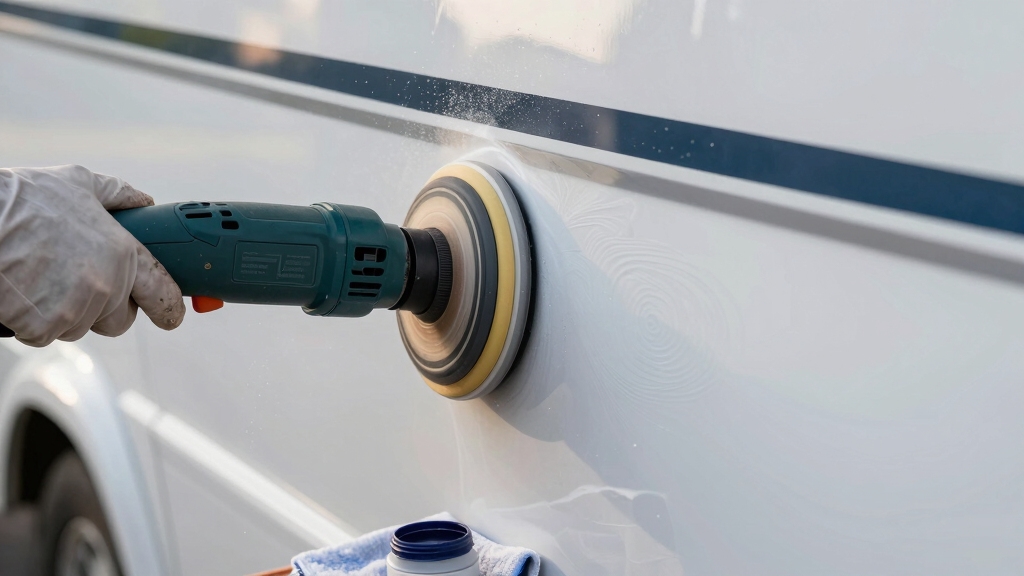
To polish RV fiberglass, first inspect for oxidation. Moderate oxidation can be treated with polishing compounds, while severe cases require wet sanding with 600-2000 grit sandpaper kept wet.
Clean the surface thoroughly, work in manageable sections, and use foam or microfiber pads with an orbital buffer at medium speed. Apply even pressure during the polishing process.
After polishing, apply wax or sealants with UV protection to extend shine and resistance. Maintaining regular care preserves the finish and prevents damage.
For detailed steps and techniques, exploring further can enhance your restoration success.
Key Takeaways
- Inspect the fiberglass surface to assess oxidation level and determine if polishing or professional restoration is needed.
- Clean the surface thoroughly and divide it into manageable 2×2 or 3-foot sections for systematic polishing.
- Use appropriate polishing compounds and foam or microfiber pads matched to oxidation severity for even abrasion.
- Apply polish with an orbital buffer at low-to-medium speed, maintaining consistent pressure and overlapping passes.
- For severe oxidation, wet sand with 600 to 2000 grit sandpaper before polishing to restore smoothness and gloss.
Assess Oxidation Levels on Your RV Fiberglass
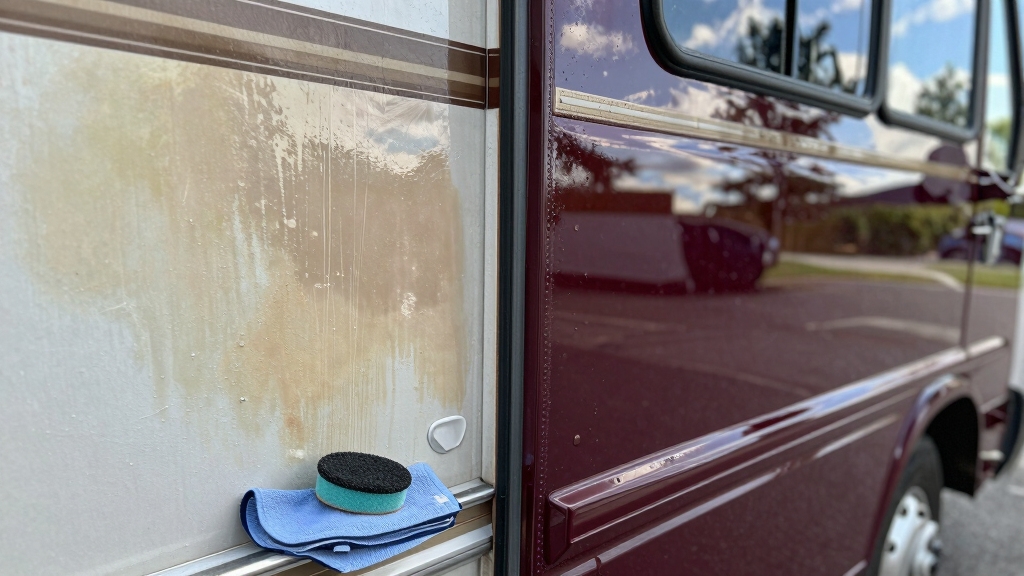
You should always start by closely inspecting your RV’s fiberglass surface to accurately assess the oxidation level.
Begin with a thorough inspection of your RV’s fiberglass to determine the extent of oxidation accurately.
Divide the surface into manageable 2×2 or 3-foot sections for systematic evaluation.
Run your fingers over the gelcoat; a hard, smooth feel indicates intact gelcoat, while visible fibers suggest a pigmented finish requiring different care.
For oxidation, classify it as none, moderate, or extreme.
Moderate oxidation appears as a chalky, faded layer that can be treated with polishing compounds or oxidation removers.
Extreme oxidation involves deep degradation where wet sanding with 600 to 2000 grit sandpaper is necessary.
Accurately identifying this helps determine the correct restoration method and prevents unnecessary damage.
Consistent section inspection guarantees even treatment and optimal results during polishing.
Using products with diminishing abrasives can effectively restore gloss during moderate oxidation without causing surface damage.
Choose the Right Polishing Compounds for Oxidation Removal
When tackling oxidation removal, selecting the appropriate polishing compound is vital for effective restoration without damaging the fiberglass surface.
For moderate oxidation, use a liquid abrasive or an oxidation remover designed to lift the oxidized layer without aggressive abrasion.
These products let you rub, dry, then peel off the residue, revealing a cleaner gelcoat.
In extreme cases, after wet sanding, apply super-duty polishing compounds to eliminate sanding marks and restore gloss.
Choose compounds compatible with gelcoat finishes, like 3M Perfect-It gelcoat medium polish, which also adds a protective wax layer.
Use foam or microfiber pads for even distribution, avoiding wool pads unless paired with an orbital polisher for heavily oxidized, chalky surfaces.
Matching compound aggressiveness to oxidation level guarantees efficient removal and preserves gelcoat integrity.
For repairs following polishing, consider using J-B Weld Plastic Bonder for its strong, water-resistant bond and quick setting time to fix any damaged fiberglass areas.
Prepare Your RV Fiberglass Surface for Polishing and Sanding
Hey there! Let’s get your RV’s fiberglass surface ready for some polishing and sanding. First things first, it’s a good idea to break down the task into smaller, manageable sections—think about 2×2 or 3-foot areas. This way, you can ensure that your polishing and sanding are nice and even.
Now, before you jump in, take a close look at how oxidized the surface is. If it’s just light to moderate damage, you can go ahead and use some polish. But if you notice that the oxidation is pretty severe, you might need to consider wet sanding instead.
Oh, and don’t forget to check the surface texture while you’re at it! If it feels hard and smooth, you’re likely dealing with gelcoat. However, if you see visible fibers, that points to a pigmented finish, which means you’ll need to switch up your approach a bit. Happy prepping!
For ongoing care, consider using cleaners with UV protection features to help maintain the surface and prolong its lifespan.
Assess Oxidation Level
Before applying any polish or sanding, you need to assess the oxidation level on your RV’s fiberglass surface carefully. This determines whether you’ll use a polish or wet sanding.
Start by inspecting the surface visually and by touch:
Look for dull, chalky areas indicating moderate to extreme oxidation.
Feel the surface: a hard, smooth finish means gelcoat; visible fibers suggest a pigmented finish.
Test a small area with an oxidation remover or polishing compound; moderate oxidation will rub off easily.
For severe oxidation, the surface requires wet sanding with 600 to 2000 grit sandpaper soaked for 24 hours.
Accurate oxidation assessment guarantees you choose the right restoration method, preventing damage and optimizing your RV’s finish restoration.
Applying a suitable acrylic coating after polishing can protect the fiberglass surface from UV damage and maintain its appearance longer.
Divide Surface Sections
Although dividing the surface into manageable sections might seem simple, it’s essential for guaranteeing even polishing and sanding.
You’ll want to break your RV fiberglass into 2×2 foot or 3-foot sections, depending on accessibility and tool size.
This approach helps maintain consistent pressure and compound coverage, preventing uneven finishes or missed spots.
Mark each section lightly with a pencil or removable tape to track progress.
Working systematically, complete one section before moving on to the next, which also reduces fatigue and improves control.
Dividing the surface allows you to tailor your polishing method based on oxidation severity within each area.
This precision guarantees efficient compound use and optimal results, setting a solid foundation before moving on to finer steps like identifying gelcoat texture or detailed polishing.
For best results, ensure the surface is clean and properly prepared as surface preparation is critical to long-term finish quality.
Identify Gelcoat Texture
Understanding the gelcoat texture is essential for selecting the right polishing or sanding technique on your RV fiberglass. You’ll want to assess the surface carefully to determine whether it’s gelcoat or a pigmented finish, as this affects the approach.
Here’s how to identify gelcoat texture:
Feel the surface; gelcoat is hard and smooth, unlike rough or fibrous finishes.
Look for visible fibers beneath the surface; their presence indicates non-gelcoat layers.
Check for chalky or faded oxidation, common on gelcoat needing polish or wet sanding.
Test a small area with a polishing compound; gelcoat responds by smoothing and shining.
Accurately identifying gelcoat texture guarantees you apply the appropriate restoration method without damaging your RV’s finish.
Using products with UV inhibitors and acrylic polymer sealants helps protect and maintain the restored gelcoat surface for years.
Wet Sanding Techniques for Extreme Fiberglass Oxidation
Tackle extreme oxidation on your RV’s fiberglass by starting with wet sanding, a crucial step to restore heavily damaged gelcoat surfaces.
Soak 600 to 2000 grit wet sandpaper for at least 24 hours before use to make certain uniform abrasion.
Divide the surface into manageable 2×2 or 3-foot sections, maintaining consistent pressure while sanding in overlapping, circular motions.
Keep the surface wet throughout to prevent heat buildup and minimize scratch depth.
Regularly check the surface texture—smoothness indicates you’ve reached the gelcoat layer, while exposed fibers signal over-sanding.
After sanding, thoroughly rinse and dry the area before applying a super-duty polishing compound to remove sanding marks and restore gloss.
This method effectively removes thick oxidation, preparing the surface for subsequent polishing and waxing steps.
For ongoing protection, consider using products with UV protection to prevent future fading and deterioration caused by sun exposure.
Step-by-Step Oxidation Removal for RV Gelcoat
Once you’ve completed wet sanding to remove extreme oxidation, the next step is to systematically restore the gelcoat’s shine through polishing.
Begin by dividing the surface into manageable 2×2 or 3-foot sections for even application. Use a super-duty polishing compound on a foam or microfiber pad to break down sanding scratches and oxidation residues.
Work in overlapping patterns with an orbital buffer at medium speed, spreading the compound evenly. After polishing each section, wipe with a clean microfiber cloth to inspect progress before moving on.
Key steps include:
- Apply super-duty polish in thin, consistent layers
- Buff with orbital polisher using overlapping motions
- Frequently check for uniform gloss and scratch removal
- Remove residue with microfiber cloth before final inspection
This process revives gelcoat clarity and prepares it for protective finishing. Applying a high-quality RV roof coating afterward can significantly extend the lifespan of your fiberglass surface.
Hand Polishing Methods for a Smooth, Glossy Finish
So, to get started, you’ll want to apply a small amount of polishing compound evenly across a 2×2 foot section. Just use circular motions as you do this. It’s really important to keep your hand flat and maintain consistent pressure. This will help you avoid any streaks and ensure that the abrasion is uniform.
Once you’ve done that, the next step is to buff it out gently. Grab a clean, soft cloth or a fresh pad, and give it a good buffing. This will help bring out that beautiful high-gloss shine you’re aiming for! To protect your work and extend the shine’s life, consider applying a wax with UV inhibitors after polishing.
Applying Compound Evenly
Although hand polishing requires patience, applying the compound evenly is essential to achieve a smooth, glossy finish on your RV fiberglass. You need to spread the compound uniformly to avoid streaks and inconsistent shine.
Focus on small sections, about 2×2 feet, to maintain control and thorough coverage. Use a foam or microfiber pad to distribute the compound gently but completely.
Keep these tips in mind:
- Apply a small amount of compound and work in circular motions.
- Maintain a flat hand with even pressure to prevent uneven polishing.
- Frequently inspect the surface for missed spots or buildup.
- Buff gently with a clean cloth or fresh pad to enhance gloss.
Consistent, even application guarantees ideal results without overworking the gelcoat. Using energy-efficient LED lighting can help highlight imperfections better during the polishing process, ensuring a flawless finish.
Consistent Pressure Technique
Applying compound evenly lays the groundwork, but maintaining consistent pressure during hand polishing guarantees the gelcoat wears uniformly and shines smoothly.
You should keep your hand flat and apply steady, even force to avoid uneven abrasion or swirl marks. Work section by section, frequently inspecting to catch pressure inconsistencies early.
Using the right pad helps distribute pressure evenly.
| Pressure Level | Effect on Gelcoat |
|---|---|
| Too Light | Ineffective polishing |
| Moderate & Even | Uniform gloss and finish |
| Too Heavy | Risk of burn-through |
| Uneven Pressure | Streaks and swirl marks |
| Consistent Motion | Smooth, glossy surface |
Mastering this technique results in a consistent, smooth surface ready for buffing without damaging the fiberglass.
Buffing For High Shine
Buffing enhances the polished surface by removing residual haze and refining the gelcoat’s shine. To achieve a smooth, glossy finish by hand, focus on consistent technique and quality materials.
Use a clean, soft buffing cloth or fresh foam pad for best results. Work in small, manageable sections to maintain control and uniformity.
Key steps for effective hand buffing include:
Apply gentle, even pressure with flat hand contact to avoid swirl marks. Use circular motions to distribute polish evenly and break down residues.
Frequently inspect the surface for haze or missed spots, reapplying polish if needed. Finish by wiping with a microfiber cloth to reveal a high-gloss, clear finish.
This method guarantees your RV fiberglass gleams with durable, professional-grade shine.
Using Machine Polishers Safely and Effectively on Your RV
Master machine polishing your RV fiberglass by starting with low-to-medium speed settings to prevent surface damage and guarantee controlled compound distribution.
Apply polish evenly on a foam or microfiber pad, then work in overlapping passes over 2×2 or 3-foot sections.
Maintain consistent pressure and keep the buffer flat against the surface to avoid swirl marks or uneven polishing.
After spreading the compound, you can increase speed slightly for effective buffing, but never exceed manufacturer recommendations.
Frequently stop to inspect the surface and wipe residue with a microfiber cloth to check your progress.
Finish each section by hand polishing any dry spots or edges the machine missed.
Always use appropriate pads: foam for general polishing and wool for heavily oxidized areas.
Avoid prolonged contact in one spot to protect the gelcoat.
Applying Wax and Sealants to Protect Your RV’s Shine
To keep your RV looking shiny and new, you’ll want to choose a wax designed specifically for gelcoat surfaces. This kind of wax offers durability and helps protect against harmful UV rays.
When it comes to applying sealants, make sure you use a clean, soft cloth or an applicator pad. Just follow the instructions from the manufacturer to avoid any streaks or patchy spots.
Oh, and don’t forget about layering! Properly layering your wax and sealants not only creates a strong protective barrier but also helps maintain that gorgeous shine. Plus, it offers extra defense against the elements. So take your time with this process; your RV will thank you!
Choosing The Right Wax
Why does choosing the right wax matter for your RV’s fiberglass finish? The proper wax guarantees peak protection, enhances gloss, and extends the life of your gelcoat.
Using the wrong wax can leave residue, reduce durability, or fail to shield against UV damage and environmental contaminants.
When selecting wax, consider these factors:
- Compatibility: Match wax type to your fiberglass’s finish, whether it’s gelcoat or pigmented.
- Durability: Opt for waxes with long-lasting polymers for extended protection.
- Application: Choose formulas that spread evenly and buff easily without streaking.
- Protection: Prioritize UV resistance, water repellency, and oxidation prevention.
Selecting the right wax maximizes your polish efforts and preserves your RV’s shine effectively.
Applying Sealants Properly
When applying wax and sealants, ensuring an even, thin layer on your RV’s fiberglass surface is crucial for maximum protection and shine.
Divide the surface into manageable sections, typically 2×2 or 3×3 feet, to maintain control.
Use a clean foam or microfiber applicator pad, applying the product with consistent, light pressure in overlapping circular or linear motions.
Avoid heavy buildup, which can cause streaking or uneven curing.
Allow the sealant or wax to haze as per manufacturer instructions before buffing with a clean microfiber cloth to a high gloss.
For best results, apply multiple thin coats rather than one thick layer.
Regularly inspect your work to catch missed spots.
Proper application extends the gelcoat’s durability and preserves the polished finish against environmental damage.
Routine Maintenance Tips for Long-Lasting RV Fiberglass Gloss
Regularly inspecting and polishing your RV’s fiberglass surface guarantees its gloss remains vibrant and protected.
Consistent inspection and polishing keep your RV’s fiberglass looking vibrant and well-protected.
Maintaining a high-quality finish demands consistent care and timely touch-ups. Focus on these key practices:
Inspect sections after each polish to spot uneven gloss or oxidation early.
Use appropriate polishing compounds and waxes to reinforce protection and shine.
Clean surfaces thoroughly before polishing to avoid embedding dirt or grit.
Apply wax or ceramic sealants post-polishing for extended environmental resistance.
When to Seek Professional Help for RV Fiberglass Restoration?
Even with consistent care, some fiberglass damage exceeds what routine polishing and waxing can fix effectively. When you notice deep scratches, extensive oxidation, or exposed fibers, it’s time to seek professional restoration.
Professionals have specialized tools and materials to restore gelcoat integrity and finish.
| Condition | Recommended Action |
|---|---|
| Minor oxidation | DIY polishing and waxing |
| Moderate oxidation | Use advanced compounds or seek advice |
| Deep scratches or cracks | Professional repair required |
| Exposed fiberglass or delamination | Immediate professional intervention |
If you find the surface rough after polishing or the damage covers large areas, avoid further DIY attempts. A pro can safely wet sand, apply super-duty compounds, and restore long-term protection. This prevents costly damage and preserves your RV’s value.
Frequently Asked Questions
Can Polishing Remove Deep Scratches or Cracks in RV Fiberglass?
Polishing can remove light to moderate scratches by abrading the gelcoat surface, but it won’t fix deep scratches or cracks in your RV fiberglass.
For deep damage, you’ll need wet sanding followed by multiple polishing stages or professional repair.
Polishing smooths and restores shine but can’t fill or structurally repair cracks.
Always assess the damage first; if scratches penetrate the gelcoat noticeably, polishing alone won’t suffice.
How Often Should I Polish My RV Fiberglass Each Year?
You should polish your RV fiberglass 1 to 2 times per year, ideally in spring and fall, to maintain gloss and protect the gelcoat.
Frequency depends on exposure to sun, weather, and oxidation levels. If you notice dullness or oxidation, polish more often.
Regular polishing prevents buildup and extends surface life. Always follow with a wax or sealant for added protection and inspect sections during polishing for consistent coverage.
What Safety Gear Is Recommended During the Polishing Process?
You should wear safety goggles to protect your eyes from polish splatter and dust.
Use a dust mask or respirator to avoid inhaling fine particles, especially when wet sanding or using abrasive compounds.
Gloves protect your hands from chemicals and abrasions.
Wear long sleeves and pants to shield your skin.
Make certain good ventilation in your workspace to reduce fumes.
These precautions keep you safe and comfortable throughout polishing.
Can I Use Household Products to Polish RV Fiberglass?
Using household products to polish RV fiberglass is like trying to sharpen a fine blade with a butter knife. They just don’t have the right grit or formulation.
You need specialized polishing compounds designed to remove oxidation and scratches effectively without damaging the gelcoat.
Household cleaners lack abrasives and protective elements, so relying on them risks dulling or harming the surface.
Stick to marine-grade polishes and oxidation removers for safe, durable results.
How Does Weather Affect the Polishing and Curing of Wax or Sealants?
Weather impacts waxing and sealing by affecting curing time and adhesion.
You shouldn’t apply wax or sealants in direct sunlight or extreme heat, as they dry too fast, causing uneven layers or streaks.
Cold or humid conditions slow curing, risking poor bonding and reduced durability.
Aim for moderate temperatures (60-80°F) with low humidity.
Also, avoid polishing before rain to guarantee proper sealant setting and protection longevity.
Final Polish: Keeping Your RV Road-Ready and Radiant
Polishing your RV’s fiberglass is like tuning a finely crafted instrument. You need the right tools, precise techniques, and consistent care to keep it performing at its best.
By evaluating oxidation, choosing proper compounds, and protecting your finish, you guarantee your RV shines like new.
Remember, routine maintenance is your daily practice, while professional help is the expert’s touch when the damage runs deep. Stay diligent, and your RV will always hit the right note on the road.