
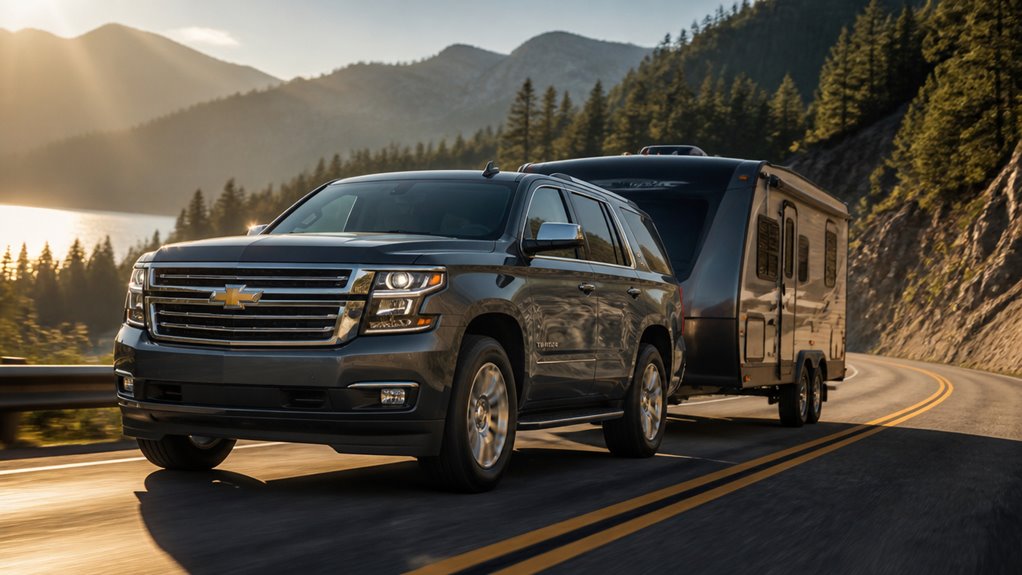
Yes, your Tahoe can definitely pull a camper, as long as you match the camper’s weight to your Tahoe’s engine, drivetrain, and towing package limits.
Most Tahoe models tow between 7,600 and 8,400 pounds, with rear-wheel drive and the 5.3-liter V-8 offering the highest capacity.
Proper hitch setup, weight distribution, and correct tire selection are vital for safe towing.
To confidently tow without risking damage or poor handling, understanding these factors is essential for your trip.
Key Takeaways
- A Tahoe can tow campers up to about 8,400 pounds depending on engine, drivetrain, and towing package configuration.
- Lightweight and mid-size campers weighing 3,000 to 7,500 pounds generally fit within the Tahoe’s towing capacity.
- Proper tongue weight (10–15% of trailer weight) and weight distribution hitches improve stability and handling when towing.
- Using the Max Trailering Package and correct hitch setup enhances towing safety and vehicle performance.
- Matching trailer tires to load ratings and monitoring tire condition is essential for safe camper towing.
How Much Weight Can a Tahoe Tow With a Camper?

Understanding how much weight your Chevrolet Tahoe can tow with a camper is vital for safe and effective hauling. Depending on your Tahoe’s engine, drivetrain, and towing package, it can pull up to 8,400 pounds.
Knowing your Chevrolet Tahoe’s towing capacity ensures safe and efficient camper hauling.
For instance, models with the 5.3-liter V-8 and rear-wheel drive reach this peak rating. The 6.2-liter V-8 and 3.0-liter diesel options offer slightly lower but still strong capacities near 8,200 pounds.
Two-wheel-drive versions typically tow about 200 pounds more than four-wheel-drive models. Keep in mind that base towing capacities start around 7,600 to 7,900 pounds before adding towing equipment.
Verifying your exact model’s rating is essential. Choosing a camper within these limits guarantees your Tahoe performs safely and efficiently on the road.
To maximize towing safety and tire performance, it is important to select tires with appropriate load rating and ply construction matching your towing requirements.
Which Campers Fit Within Tahoe’s Towing Limits?
You can tow a range of campers with your Tahoe, from lightweight pop-ups to mid-size travel trailers, as long as you stay within its towing limits. Just a heads-up: the maximum tow capacity can vary depending on the engine, drivetrain, and towing package you have. Generally, it peaks around 8,400 pounds.
When you’re considering a camper, don’t forget to factor in its dry weight, cargo load, and tongue weight. It’s super important for safe and efficient towing, so make sure you’re keeping everything in check! To improve towing stability and safety, consider using a weight distribution hitch to balance the trailer’s tongue weight and reduce sway.
Lightweight Camper Options
Several lightweight camper models fit comfortably within the Chevrolet Tahoe’s towing limits, making it a versatile option for many recreational setups.
For instance, pop-up campers and compact trailers like the SylvanSport VAST, weighing around 4,420 pounds dry, provide easy towing without nearing the Tahoe’s maximum capacity.
Most lightweight campers fall between 3,000 and 6,000 pounds, well below the Tahoe’s 8,400-pound limit when properly equipped.
You’ll want to take into account the camper’s dry weight, cargo capacity, and tongue weight to ensure safe towing.
Lightweight campers usually require minimal additional towing equipment, but using a weight distribution hitch can improve stability.
Keep in mind that engine choice, drivetrain, and the Max Trailering Package affect your Tahoe’s exact towing capability.
Verify your vehicle’s configuration before selecting a camper.
Also, it’s important to match the camper’s weight with the appropriate Load Range G trailer tires to ensure safety and optimal performance during towing.
Mid-Size Travel Trailers
While lightweight campers offer easy towing options for many Chevrolet Tahoe owners, mid-size travel trailers provide a step up in space and amenities without exceeding the Tahoe’s towing limits.
These trailers typically weigh between 5,000 and 7,500 pounds, fitting well within the Tahoe’s maximum towing capacity of up to 8,400 pounds when properly equipped.
You’ll find models offering enhanced living space, kitchens, and bathrooms, making them ideal for longer trips.
To stay within safe towing limits, make sure your Tahoe’s engine, drivetrain, and towing package support your camper’s weight.
Mid-size travel trailers often require a weight distribution hitch for balanced handling.
Choosing tires with Load Range E ratings ensures durability and safety for towing heavier campers.
Tow Capacity Considerations
Understanding your Tahoe’s tow capacity is crucial when selecting a camper to guarantee safe and efficient towing. Depending on your Tahoe’s engine, drivetrain, and towing package, its maximum tow rating ranges up to 8,400 pounds.
This means you can confidently tow pop-up campers and small to midsize travel trailers within that limit. Before choosing a camper, check your Tahoe’s specific configuration and tow rating, as it varies by model year and setup.
Keep in mind that payload, tongue weight, and cargo loaded on the camper affect towing safety. Using a weight distribution hitch and trailer tire monitoring can enhance stability and safety.
Avoid trailers exceeding your Tahoe’s rated capacity to prevent handling issues and mechanical strain. Additionally, selecting tires with the appropriate load rating and tread depth is essential to ensure safe towing performance.
Which Tahoe Engines and Drivetrains Are Best for Towing a Camper?
Choosing the right engine and drivetrain for your Chevrolet Tahoe is essential to maximize its towing potential when pulling a camper.
The 5.3-liter V8 paired with rear-wheel drive offers the highest towing capacity, reaching up to 8,400 pounds, making it ideal for heavier travel trailers.
The 6.2-liter V8 also provides strong towing, rated around 8,200 to 8,300 pounds, though actual capacity varies by configuration.
The 3.0-liter diesel delivers solid performance for long hauls and steep grades, with an 8,200-pound tow rating.
Generally, 2WD versions can tow slightly more—up to 200 pounds—than their 4WD counterparts.
Selecting the right drivetrain depends on your terrain and towing needs, but pairing a robust engine with rear-wheel drive often yields the best camper towing results in a Tahoe.
To ensure safety and longevity during towing, it is crucial to select motorhome tires with a sufficient load capacity rating that meets or exceeds your rig’s gross vehicle weight rating.
How Towing Packages and Hitch Setup Help You Tow a Camper With Your Tahoe?
Because towing a camper safely depends on more than just your Tahoe’s raw power, equipping your vehicle with the right towing packages and hitch setup plays an essential role in maximizing performance and stability.
The Max Trailering Package enhances cooling, adds a trailer brake controller, and improves suspension, enabling you to tow near the 8,400-pound limit confidently.
Meanwhile, your hitch setup, including a properly rated receiver and possibly a weight distribution hitch, guarantees balanced load transfer and safer handling on the road.
Choosing a hitch with shock absorption features can further reduce stress on your vehicle and trailer during sharp turns and uneven terrain.
| Component | Benefit |
|---|---|
| Max Trailering Package | Boosts tow capacity & safety |
| Trailer Brake Controller | Controls trailer braking |
| Heavy-Duty Hitch | Supports rated trailer weight |
| Weight Distribution Hitch | Improves stability & handling |
| Trailer Tire Monitor | Alerts to tire issues promptly |
Together, these elements help your Tahoe tow a camper efficiently and securely.
Why Do Weight Distribution and Load Balance Matter for Tahoe Towing?
When towing a camper with your Tahoe, proper weight distribution and load balance play a pivotal role in maintaining control and safety on the road.
Uneven weight can cause trailer sway, reduce steering responsiveness, and increase braking distances, putting you at risk.
Ensuring the camper’s tongue weight is correctly balanced—typically 10-15% of the trailer’s total weight—helps keep the rear of your Tahoe stable and the front wheels firmly on the ground.
Using a weight distribution hitch can further improve handling by distributing forces evenly across the tow vehicle and trailer axles.
Proper load balance also minimizes stress on your Tahoe’s suspension and drivetrain, enhancing towing performance and reducing wear.
Additionally, selecting trailer tires with the appropriate load capacity and ply rating is essential to safely support your camper’s weight and ensure a smooth journey.
What Common Towing Mistakes Should Tahoe Owners Avoid?
When you’re towing with your Tahoe, it’s super important to get an accurate estimate of your camper’s trailer weight. If you don’t, you might end up exceeding your Tahoe’s towing capacity, which is definitely something you want to avoid.
Also, don’t skip over the hitch setup! Properly setting up the hitch, including weight distribution, is key. If you overlook this, it can lead to some pretty poor handling and unsafe towing conditions.
Choosing the right towing tires with adequate load capacity and durability is essential to ensure safety and prevent tire failure during your trip.
Incorrect Trailer Weight Estimation
Getting a clear and accurate trailer weight estimate is crucial for safe towing with your Tahoe.
Underestimating the trailer’s actual weight can lead to dangerous handling, excessive strain on your vehicle, and possible damage.
Avoid these common pitfalls:
- Relying solely on the camper’s dry weight without factoring in cargo, water, and additional gear.
- Overlooking tongue weight, which affects rear suspension and steering control.
- Ignoring weight variations caused by aftermarket modifications or added equipment on the trailer.
- Failing to verify the combined weight against your Tahoe’s specific towing capacity, considering engine, drivetrain, and towing package.
Additionally, choosing tires with the appropriate load capacity can significantly improve towing stability and safety.
Ignoring Proper Hitch Setup
Accurately estimating trailer weight is only part of safe towing; overlooking proper hitch setup can create serious handling problems and increase wear on your Tahoe. You need to make certain the hitch matches your camper’s tongue weight and that it’s correctly installed.
Using a weight distribution hitch can help balance the load, preventing excessive rear sag and improving steering control. Failing to level the trailer with the Tahoe can lead to uneven tire wear, poor braking, and unstable sway, especially at highway speeds.
Also, make sure safety chains and electrical connections are secure and functioning. Ignoring these details compromises control and increases stress on your vehicle’s suspension and drivetrain, reducing towing safety and potentially causing costly damage. Proper hitch setup is essential for a stable, safe towing experience.
Frequently Asked Questions
Can a Tahoe Tow a Camper Off-Road or on Rough Terrain?
You can tow a camper off-road with a Tahoe, especially if you choose the Z71 trim. It adds a two-speed transfer case, underbody protection, and all-terrain tires, which help on rough terrain.
However, keep your camper within the Tahoe’s towing limits and ensure proper weight distribution. Off-road towing demands cautious driving, a solid hitch setup, and awareness of the terrain to maintain stability and prevent damage to your vehicle or trailer.
How Does Towing a Camper Affect Tahoe’s Fuel Efficiency?
Towing a camper notably reduces your Tahoe’s fuel efficiency because it adds extra weight and aerodynamic drag.
You’ll notice your miles per gallon drop, sometimes by 20-30% or more, depending on camper size and road conditions.
To optimize fuel economy, drive smoothly, maintain steady speeds, and avoid rapid acceleration.
Using the right towing setup and keeping your Tahoe well-maintained also helps minimize fuel consumption while hauling your camper.
What Maintenance Is Required After Towing a Camper With a Tahoe?
After towing a camper, your Tahoe needs a thorough check-up, like a runner cooling down after a marathon.
Inspect the brakes, transmission fluid, and engine oil for wear or overheating.
Check tire pressure and alignment, especially on trailer tires and your Tahoe’s.
Don’t forget to examine the hitch and suspension for stress.
Regular maintenance now prevents costly repairs later, ensuring your Tahoe stays reliable and safe on every trip.
Are There Specific Camper Brands Recommended for Tahoe Owners?
You should consider camper brands like SylvanSport, which offers lightweight models well within the Tahoe’s towing capacity.
Brands producing small-to-midsize travel trailers, such as Airstream, Forest River, and Jayco, often have models suitable for your Tahoe, especially those under 8,400 pounds.
Always match the camper’s weight, including cargo, to your Tahoe’s specific towing rating.
Factor in engine and drivetrain to ensure safe, efficient towing.
Can a Tahoe Tow a Camper in Snowy or Icy Conditions Safely?
Imagine towing a camper like a knight steering a chariot through a winter battlefield. Yes, you can tow a camper safely in snowy or icy conditions with your Tahoe, but it demands extra care.
Equip your Tahoe properly with 4WD, snow tires, and trailer tire monitoring. Use a weight distribution hitch and drive cautiously at reduced speeds.
Make Your Next Camper Trip Safer and Easier
When you hitch your camper to your Tahoe, imagine the smooth glide down winding roads, feeling confident in your vehicle’s strength.
Knowing your Tahoe’s towing limits, choosing the right camper, and setting up weight distribution properly turns every trip into a safe adventure.
Avoid common mistakes, and you’ll maximize performance and control.
With the right preparation, your Tahoe won’t just pull a camper; it’ll carry your dreams wherever the road leads.