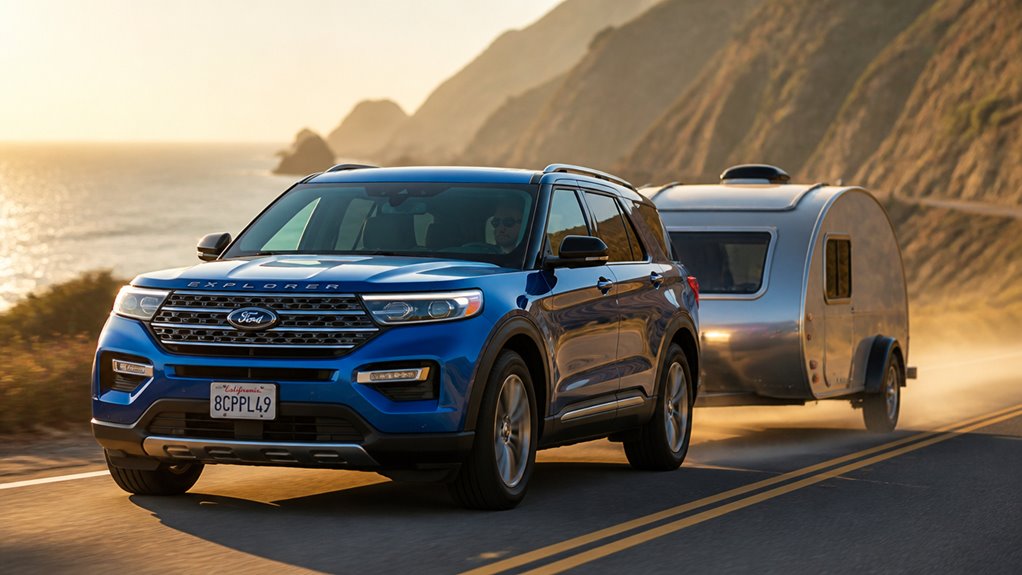
Yes, your Ford Explorer can tow a camper if it’s properly equipped.
Most models with the 3.0L EcoBoost V6 and the Class III Trailer Tow Package can handle up to around 5,000 pounds safely.
Lower trims or engines may tow closer to 2,000–3,000 pounds.
Always match your camper’s fully loaded weight to your Explorer’s towing rating, including cargo and passengers, to maintain control and safety.
Understanding engine, trim, and tow package details will help you choose the right setup.
Key Takeaways
- Properly equipped Ford Explorers with Class III Trailer Tow Package can tow campers up to 5,000–5,600 pounds safely.
- Towing capacity varies by engine type, trim, and year; verify exact model specs before selecting a camper.
- Lower trims or models without the tow package should tow campers under 3,000 pounds for safety and performance.
- Always consider fully loaded camper weight, including gear and fluids, not just dry weight, to stay within limits.
- Use appropriate tires, heavy-duty cooling, and trailer brake control for stable, safe towing with a Ford Explorer.
Ford Explorer Camper Towing Capacities

Understanding the Ford Explorer camper towing capacities is essential before you hit the road with a trailer. Depending on your Explorer’s engine, trim, drivetrain, and tow package, the maximum towing capacity can vary notably.
Many newer models, when properly equipped, can tow between 5,000 and 5,600 pounds. However, some configurations have lower ratings around 2,000 pounds. To reach the higher limits, your vehicle needs the Class III Trailer Tow Package and appropriate accessories.
Keep in mind that Ford’s stated capacities assume a properly equipped vehicle with standard cargo and passenger loads. Exceeding these limits or towing without the right setup can compromise safety and performance. Always check your specific model’s towing guide for accurate capacity before selecting a camper. For the smoothest towing experience, consider using a 5th wheel hitch compatible with your vehicle’s towing system to reduce noise and improve stability.
Engine and Trim Impact on Explorer Camper Towing
Your Ford Explorer’s engine type and trim level really play a crucial role in determining how much you can tow. Depending on your setup, you’re looking at a range from about 2,000 to 5,600 pounds. Pretty significant, right?
If you’ve got the Class III Trailer Tow Package, you’re in for the best towing ratings. This is especially true for trims like the King Ranch or Timberline. So, if you’re eyeing those models, you’re likely to get the most out of your towing capabilities.
Understanding these differences is key. It’ll help you pick the right camper that’s a perfect match for your Explorer’s specific setup and towing limits. That way, you can hit the road with confidence!
For enhanced towing safety and ease, especially with heavier campers, considering a high-capacity hitch designed for your vehicle’s load rating is essential.
Engine Variations
When choosing a Ford Explorer for towing a camper, you’ll need to pay close attention to the engine and trim level since they directly affect towing capacity. Different engines provide varying tow ratings, influencing which camper size you can safely haul.
The 2.3L EcoBoost I-4 and 3.0L EcoBoost V6 both support up to 5,000 pounds towing. The 3.3L HEV V6 hybrid generally offers up to 5,000 pounds but varies by model year and equipment.
Some trims equipped with the Class III Trailer Tow Package boost capacity to 5,600 pounds. Lower engine configurations might limit towing to around 2,000 pounds. Always verify the specific model year’s towing chart to confirm exact ratings.
Understanding these engine variations helps you match your Explorer with a camper within safe towing limits. Additionally, using a tuner to enhance engine performance can improve towing efficiency and power delivery for a smoother experience.
Trim Level Differences
Engine choices set the foundation for towing capacity, but trim levels further influence how much weight your Ford Explorer can safely handle when pulling a camper.
For example, the Timberline and ST-Line trims are rated up to 5,300 pounds. In contrast, King Ranch, ST, and Platinum trims can tow up to 5,600 pounds when properly equipped.
These differences stem from variations in suspension tuning, cooling systems, and available drivetrain options that enhance towing performance.
Lower trims or older model years may have reduced ratings, sometimes as low as 2,000 pounds, which limits your camper options.
Always check your Explorer’s exact trim and model year tow rating before selecting a camper to guarantee you stay within safe limits and maintain peak vehicle performance.
Using the correct engine oil specification is also important to maintain engine durability and performance when towing heavy loads.
Tow Package Effects
Adding the factory Class III Trailer Tow Package markedly enhances your Ford Explorer’s ability to tow a camper by upgrading critical components like the hitch receiver, wiring harness, and cooling systems.
This package is essential for achieving the maximum towing capacity offered by specific engines and trims. Without it, your towing performance and safety margins can diminish appreciably.
Key benefits include:
- Reinforced hitch receiver rated for higher tongue loads
- Integrated trailer brake controller for improved stopping power
- Heavy-duty cooling systems to prevent engine overheating
- Upgraded wiring harness for reliable trailer lighting and signals
- Suspension tuning to better handle trailer weight and dynamics
Choosing the right engine, trim, and tow package guarantees your Explorer can safely and effectively tow campers near its rated limits. Many Class 3 trailer hitches feature a standard 2-inch receiver that ensures compatibility with a wide range of towing accessories and enhances towing versatility.
Choosing the Right Camper Size for Your Explorer
When you’re picking the right camper size for your Ford Explorer, it’s super important to think about the camper’s weight and how it fits with your specific trim and engine setup. You definitely want to stay within safe towing limits.
That means you need to consider not just the camper’s dry weight, but also any extra gear you’ll be bringing along, your passengers, and the tongue load.
And hey, don’t forget about safety margins! Keeping everything within the limits ensures you won’t overload your vehicle.
This way, you’ll maintain control and stability while you’re on the road, making your adventures a lot more enjoyable.
Additionally, considering the weight capacity of your gear and camper setup helps ensure both safety and comfort during travel.
Camper Weight Considerations
Choosing the right camper size for your Ford Explorer is crucial to guarantee safe and efficient towing. You need to contemplate the actual loaded trailer weight, not just the dry weight, since gear, water, and propane add significant pounds. Staying well below your Explorer’s max towing capacity gives you a safety margin for passengers and cargo.
Keep these weight factors in mind:
- Know your Explorer’s exact tow rating based on engine, trim, and tow package.
- Factor in tongue load limits, usually max 500 pounds.
- Remember total GCWR: vehicle plus trailer can’t exceed it.
- Distribute camper weight evenly, placing heavier items above axles.
- Aim for a camper weight that leaves room for passenger and cargo loads.
Also, ensure your motorhome or trailer uses tires with adequate load capacity to safely support the weight and avoid tire failure.
Following these guidelines guarantees you tow within safe limits and maintain vehicle control.
Matching Camper To Trim
Understanding your Ford Explorer’s specific trim and configuration helps you select a camper that fits within its towing capabilities.
Different trims, engines, and drivetrains have varying tow ratings, ranging from about 2,000 pounds in some base models to 5,600 pounds in top trims like King Ranch or ST with the factory tow package.
You need to check your Explorer’s exact year, engine type, and whether it includes the Class III Trailer Tow Package before choosing a camper.
For example, a 3.0L EcoBoost V6 with the tow package can handle campers near 5,000 pounds.
Meanwhile, a lower trim without these features should stick to lighter campers under 3,000 pounds.
Matching camper weight to your Explorer’s trim guarantees you stay within limits and optimize safety and performance.
Using a wireless RV leveling system can help maintain stability and safety when towing and setting up your camper.
Safety Margins Importance
Although your Ford Explorer may have a maximum towing capacity listed in the thousands of pounds, you shouldn’t plan to tow a camper that approaches this limit without considering important safety margins.
Overloading reduces vehicle control, increases wear, and compromises braking.
To tow safely, factor in:
- Cargo, passengers, and hitch load that add to total weight
- Difference between camper dry weight and fully loaded weight
- Ford’s recommended maximum tongue load (up to 500 pounds)
- Gross combined weight rating (GCWR) limits for your Explorer model
- Proper distribution of trailer cargo to maintain stability
Choosing tires with appropriate load ratings can also help maintain vehicle stability and safety when towing heavy loads.
How Tow Packages Improve Explorer Camper Towing Safety?
When you equip your Ford Explorer with the factory Class III Trailer Tow Package, you markedly enhance its ability to tow a camper safely and efficiently.
This package includes a heavier-duty hitch receiver, trailer brake controller, and wiring harness, all designed to maintain stability and control.
It also improves braking performance and reduces trailer sway, vital for safe towing. Without it, your Explorer’s towing safety and capacity may be compromised.
Choosing the right weight distribution hitch further balances the trailer’s tongue weight, improving handling and reducing sway during towing.
| Feature | Benefit | Impact on Safety |
|---|---|---|
| Class III Hitch | Supports up to 5,000+ lbs | Proper trailer attachment |
| Trailer Brake Controller | Improved brake coordination | Shorter stopping distances |
| Wiring Harness | Reliable signal transmission | Stable trailer control |
| Sway Control | Reduces trailer sway | Enhanced steering control |
| Heavy-duty Cooling | Maintains engine temperature | Prevents overheating |
Cargo and Passenger Effects on Towing Limits
Equipping your Ford Explorer with the factory tow package sets a solid foundation for safe camper towing. You also need to take into account how cargo and passengers affect your vehicle’s towing limits.
The maximum trailer weight assumes a typical driver and passenger weight. Extra occupants and gear reduce the available towing capacity. Overloading your Explorer can lead to unsafe handling and strain on the drivetrain.
To manage this, consider:
- The combined weight of passengers, cargo, and hitch tongue load.
- How added weight reduces your effective towing margin.
- Staying well below the max trailer rating to allow for load variations.
- Distributing cargo evenly, especially over the axles.
- Monitoring your vehicle’s Gross Combined Weight Rating (GCWR).
Accounting for these factors guarantees safe, stable towing within your Explorer’s limits.
Preparing Your Explorer for Camper Towing
Before you hitch your camper, make sure your Ford Explorer is fully prepared to handle the load safely and efficiently.
Start by verifying your Explorer’s tow rating for your specific engine and trim. Confirm you have the Class III Trailer Tow Package installed, as it’s essential for maximum towing capacity.
Check tire pressure, brakes, and fluid levels to guarantee peak performance. Distribute cargo evenly to maintain stability and avoid overloading the tongue weight.
| Preparation Step | Key Detail |
|---|---|
| Verify Tow Rating | Check engine, trim, and year |
| Tow Package | Guarantee Class III Trailer Tow Package |
| Vehicle Maintenance | Inspect tires, brakes, fluids |
| Load Distribution | Balance cargo; limit tongue weight |
Proper preparation protects your Explorer and promotes a safer towing experience.
Tips for Towing a Camper Safely With Your Explorer
Towing a camper safely with your Ford Explorer requires attention to several critical factors that go beyond simply matching weight ratings. You need to contemplate your vehicle’s configuration, load distribution, and driving conditions to guarantee safe towing performance.
Here are key tips for towing safely:
Confirm your Explorer’s exact towing capacity by year, engine, trim, and tow package.
Keep trailer weight below your maximum rating, allowing room for cargo, passengers, and hitch load.
Distribute camper weight evenly, placing heavier items above the axles to improve stability.
Use trailer sway control and ensure your hitch setup matches Ford’s guidelines, including tongue weight limits.
Adjust your driving style for towing. Increase following distance, avoid sudden maneuvers, and reduce speed on inclines.
Following these tips helps maintain control and protects your vehicle and camper during your trip.
Frequently Asked Questions
What Type of Hitch Is Best for Towing a Camper With an Explorer?
You’ll want a Class III hitch for towing a camper with your Ford Explorer. This hitch supports up to 5,000 to 5,600 pounds, matching many Explorer trims’ towing capacities.
Make sure your Explorer has the factory Class III Trailer Tow Package installed for peak performance. Also, use a weight-distributing hitch if your camper is near the max rating, as it improves stability and reduces strain on your vehicle’s suspension and brakes.
How Does Weather Affect Towing a Camper With a Ford Explorer?
You should know that wind can dramatically impact towing stability. Crosswinds over 20 mph can cause sway and control issues.
Rain and snow reduce traction, increasing stopping distances and making hills tougher.
Cold weather thickens fluids and stiffens tires, reducing performance.
Always adjust your speed, increase following distance, and check tire pressure regularly. Proper weight distribution and trailer sway control become even more critical in adverse weather to maintain safe towing with your Ford Explorer.
Can an Explorer Tow a Camper on Steep or Mountainous Terrain?
Yes, you can tow a camper with your Explorer on steep or mountainous terrain, but you need to be cautious.
Steep grades increase engine strain and braking demand, so keep your camper’s weight well below your Explorer’s towing capacity.
Use lower gears to control descent speed and make certain your vehicle has the proper tow package with trailer sway control.
Always check payload limits and avoid overloading to maintain safe handling and braking.
What Maintenance Is Needed After Towing a Camper With an Explorer?
After towing a camper, you’ve given your Explorer a workout, so don’t let it rest without care.
Check the transmission fluid and engine oil for heat stress. Inspect brakes and tires for wear or damage, and tighten lug nuts.
Don’t forget to examine suspension and hitch components for strain.
Clean off any road grime or debris, and verify cooling systems are functioning well.
Regular maintenance keeps your Explorer ready for the next adventure.
Are There Specific Insurance Considerations for Towing Campers With an Explorer?
Yes, you need specific insurance coverage when towing campers with your Explorer.
Standard auto policies mightn’t cover damage or liability related to trailers, so you should add a towing or RV endorsement.
Check that your policy covers both the vehicle and the camper, including liability, full coverage, and collision.
Also, verify coverage limits for personal property inside the camper and consider roadside assistance tailored for towing situations.
Safe Camper Towing Starts With the Right Setup
When towing a camper with your Ford Explorer, think of it as steering a ship. You need balance and preparation.
Understanding your Explorer’s towing capacity, engine, and trim guarantees you don’t overload.
Adding a tow package and managing cargo and passengers will keep you safe on the road.
By preparing properly and following towing tips, you’ll navigate camper towing smoothly and confidently.
This makes every trip enjoyable and secure.