
You can plug your camper into a standard 110V household outlet, but keep your load below 10 amps to avoid tripping breakers or overheating wiring.
Low-power devices like LED lights, refrigerators, and battery chargers run safely, while high-draw appliances like air conditioners or microwaves can overload the circuit.
Verify your outlet’s grounding and capacity, and use RV-rated surge protectors and proper cords to minimize risks.
Understanding these limits helps protect your camper’s electrical system and guarantees safe power use.
Key Takeaways
- A 110V household outlet typically supports up to 15 amps but it’s safest to keep camper load below 10 amps to avoid overload.
- Low-wattage camper appliances like LED lights, battery chargers, and small refrigerators can safely run on a 110V outlet.
- Avoid using high-wattage devices such as air conditioners, microwaves, or space heaters on a 110V outlet to prevent breaker trips.
- Always verify outlet grounding, wiring, and GFCI protection before connecting your camper to ensure safety and prevent electrical faults.
- Use RV-rated surge protectors and avoid undersized extension cords to protect your camper’s electrical system from damage and overheating.
Typical Power Capacity of a 110V Outlet for Campers
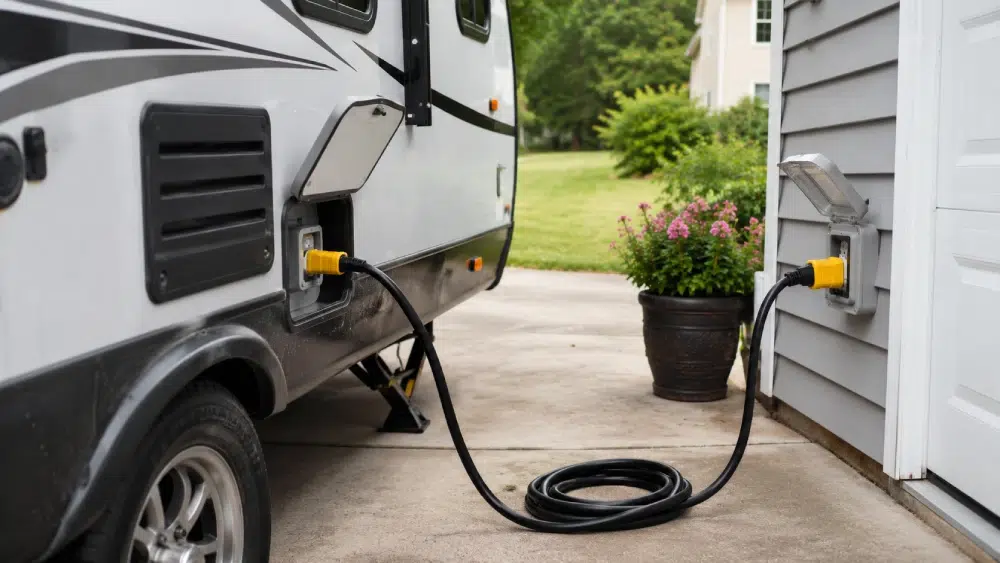
A standard 110V household outlet typically provides up to 15 amps at 120 volts, which translates to a maximum theoretical power capacity of about 1,800 watts.
When you plug your camper into such an outlet, understand that this capacity supports only light electrical loads like interior lighting, battery charging, or running a small fridge.
Heavy appliances, such as air conditioners or water heaters, can quickly exceed this limit, risking circuit overload. To maintain safe operation, keep your total amperage draw well below 15 amps; many experts recommend a 10-amp ceiling to reduce overheating risk.
Using an RV surge protector can help safeguard your camper’s electrical system from potential power fluctuations at these outlets.
Why Amps Matter More Than Voltage for Your Camper?
When it comes to your camper, it’s all about paying attention to the amperage limits of your household circuit. If you exceed those limits, you’re looking at risks like overheating and tripping breakers. Yikes!
Now, while voltage stays pretty steady at the standard 110–120 volts, it’s really the current draw that decides if your camper’s appliances can run safely. So, managing those high current loads is key. It not only prevents damage to your wiring but also ensures that you have reliable power for all the essential functions you need.
In short, keep an eye on those amps, and you’ll be much better off in the long run! Using an automatic transfer switch can help protect your camper’s electrical system during power transitions.
Understanding Circuit Amperage Limits
Although voltage determines the compatibility of your camper’s electrical system with the power source, the amperage limit of the circuit dictates how much load you can safely draw.
A standard 110/120V household outlet typically supports 15 amps, translating to a maximum theoretical power capacity of about 1,800 watts.
However, continuous loads should remain below this to prevent overheating or tripping breakers.
When you plug your camper into such an outlet, you must monitor the total current draw from all active appliances, ensuring it stays well within the amperage threshold.
Consequently, understanding and respecting the circuit’s amperage rating is critical for safe operation, especially since adapters or cords don’t increase the circuit’s capacity.
Using lead-free brass components in your camper’s electrical and plumbing systems enhances safety and durability.
Impact Of High Current Draw
Since voltage remains relatively constant in standard household outlets, the real limiting factor for powering your camper is the current—the amperage—that the circuit can safely handle.
A typical 110-volt, 15-amp circuit delivers roughly 1,800 watts maximum, but continuous high current draw risks overheating wiring and tripping breakers.
For example, a 1,500-watt heater alone approaches 12.5 amps, leaving little capacity for additional loads.
You must manage your camper’s total amperage carefully, avoiding simultaneous operation of high-draw appliances like air conditioners or water heaters.
Overloading not only endangers safety but compromises electrical stability.
Adapters don’t increase circuit capacity; they only match plugs.
Hence, monitoring and limiting amperage is critical to prevent electrical faults and assure reliable, safe power when using a 110-volt household outlet for your camper.
Using the proper wire gauge and material quality in adapters is essential to maintain safe power delivery and prevent failures.
Which RV Appliances Can Safely Run on a 110V Outlet?
Typically, only low-wattage RV appliances run safely on a standard 110V household outlet due to its limited amperage capacity. You can use devices like LED lights or a small refrigerator that draw minimal current. High-demand appliances such as air conditioners or microwaves exceed the circuit’s safe limit and risk tripping breakers or overheating wiring.
| Appliance | Approximate Wattage | Safe on 110V Outlet? | Notes |
|---|---|---|---|
| LED Lighting | 10-50 W | Yes | Low power draw |
| RV Refrigerator | 100-300 W | Yes | Continuous, but low wattage |
| Battery Charger | 50-150 W | Yes | Moderate load |
| Microwave Oven | 700-1200 W | No | High current draw |
| Air Conditioner | 1000-1500 W | No | Exceeds 15A circuit safely limit |
Stick to low-wattage appliances to maintain safe operation on a 110V outlet. Using a charger with multi-stage smart charging can help protect your RV batteries during charging from a 110V source.
Checking If Your Household Outlet Is Safe for Camper Use
Before plugging your camper into a household outlet, you need to verify the outlet’s wiring, grounding, and circuit capacity to guarantee safe operation.
Use a circuit tester to confirm proper wiring and grounding; a miswired or ungrounded outlet poses shock and fire risks.
Make sure the outlet is rated for 15 amps and ideally GFCI-protected, especially for outdoor use.
Confirm the circuit isn’t heavily loaded by other devices, as shared loads can cause voltage drops or tripping.
Check the voltage remains within 108 to 125 volts to protect your camper’s appliances.
Avoid using outlets designed for 220–240 volts unless the setup explicitly supports your camper.
Proper verification prevents overloads and hazards, ensuring your household outlet can safely support limited camper loads without compromising electrical integrity.
To further protect your camper’s electrical system, consider using a surge protector designed for RV use to guard against voltage spikes and wiring faults.
Using Adapters and Extension Cords Safely to Avoid Overloads
Verifying your outlet’s wiring and capacity sets the foundation for safe camper power.
Adapters and extension cords also play a significant role in managing electrical load. Use only RV-rated adapters that match your camper’s plug type. They don’t increase circuit capacity but guarantee proper connection.
Avoid undersized or coiled extension cords, as they cause voltage drop and heat buildup, increasing overload risk. Fully uncoil extension cords to dissipate heat effectively.
Limit extension cord length to reduce resistance and maintain voltage within safe ranges. Incorporate an RV-rated surge protector or power management device to monitor load and prevent overheating.
Always confirm the outlet’s amperage rating before use. Never rely on adapters or cords to compensate for a circuit’s load limitations. Proper selection and deployment of adapters and cords are critical to avoiding electrical overloads.
Using a battery monitor can further help ensure your camper’s electrical system remains within safe operating parameters.
What Happens When You Overload a 110V Household Outlet?
When you overload a 110V household outlet, the electrical wiring inside your home risks overheating. This can lead to circuit breaker trips or, in severe cases, electrical fires.
Exceeding the 15-amp capacity causes excessive current flow, raising conductor temperatures beyond safe limits. This degrades insulation, increasing short-circuit and fire hazards.
The thermal protection from breakers trips the circuit to prevent damage, but repeated overloads can weaken wiring integrity. High-draw devices like air conditioners or heaters rapidly push amperage close to or above the outlet’s limit.
Additionally, voltage drop and heat buildup in undersized or long extension cords exacerbate risk. Overloading compromises both safety and electrical system reliability.
This underscores the need to monitor and limit total amperage when powering your camper from a standard household outlet. For RV camping, using a generator with appropriate power output can prevent such electrical hazards.
Managing Camper Power Settings for 110V Outlets
Monitoring and adjusting your camper’s power settings becomes essential to prevent overloading a 110V household outlet.
Since these outlets typically supply 15 amps at 110–120 volts, you must limit your load to roughly 10 amps to guarantee safety and avoid tripping the breaker.
Focus on managing electrical consumption by prioritizing essential functions and disabling high-wattage appliances when connected to such circuits.
To effectively manage power settings, consider the following:
- Reduce RV amperage settings if adjustable to match outlet capacity.
- Turn off or unplug non-essential appliances like air conditioners or heaters.
- Use RV-rated surge protectors and test outlets for proper grounding and voltage.
Using a generator with inverter technology can help provide stable and clean power to sensitive camper electronics when shore power is limited.
When to Avoid Using a 110V Household Outlet for Your Camper?
When you’re out camping, it’s best to steer clear of using a 110V household outlet for certain high-wattage appliances. For instance, things like air conditioners and heaters can really crank up the power draw. If you’re not careful, you could easily exceed the circuit’s amperage limit, which can lead to overheating.
Also, be mindful of where you’re plugging in. If the outlets are improperly grounded, lack GFCI protection, or share circuits with other heavy loads, that’s a big red flag. These situations can really ramp up the risk of fire and damage.
Before you connect anything, take a moment to assess your outlet’s wiring and load capacity. It’s all about ensuring your safety and avoiding any electrical hazards while you enjoy your time outdoors!
High Power Appliance Risks
Avoid plugging high-power appliances like air conditioners, space heaters, or water heaters into a 110V household outlet for your camper.
These devices often exceed the typical 15-amp circuit capacity, risking circuit overload and potential fire hazards.
You should strictly limit your camper’s electrical load to avoid tripping breakers or damaging wiring.
Consider these risks when using a standard outlet:
Continuous operation of high-wattage equipment can draw near or above 12.5 amps, approaching the 15-amp limit.
Overloading increases heat in wiring and connections, raising fire risk.
Adapters or extension cords don’t increase outlet capacity; improper use can exacerbate voltage drop and overheating.
For safety and reliability, reserve 110V outlets for low-demand functions like lighting or battery charging only.
For inflating your RV tires safely and efficiently, consider using a tire inflator with a minimum pressure capacity of 150 PSI to ensure compatibility and faster inflation times.
Unsafe Outlet Conditions
Although plugging your camper into a standard 110V household outlet can be convenient, you shouldn’t use outlets that show signs of improper wiring, lack grounding, or aren’t GFCI protected, especially outdoors.
These conditions increase shock and fire hazards, compromising safety. Avoid outlets with reversed polarity, open grounds, or loose connections, as these can cause voltage instability and damage your camper’s electrical system.
Also, don’t rely on outlets on circuits shared with heavy loads or multiple devices, which risk overload and tripped breakers. Using undersized or damaged extension cords further exacerbates risk through heat buildup and voltage drop.
Always verify outlet integrity with a tester before connecting. If you detect any wiring faults or lack of GFCI protection, avoid using that outlet to assure safe, reliable power for your camper’s limited 110V needs.
Safer Power Alternatives to 110V Household Outlets for Campers
Exploring safer power alternatives to standard 110V household outlets is essential when your camper demands more reliable and higher-capacity electrical supply.
Relying solely on a 15-amp 110V outlet limits your ability to run multiple high-draw appliances safely, risking circuit overload and fire hazards.
Instead, consider options designed specifically for RV power needs:
30-Amp RV Shore Power: Provides up to 3,600 watts, supporting air conditioners and multiple devices without tripping breakers.
50-Amp RV Service: Delivers up to 12,000 watts, ideal for larger campers with extensive electrical loads.
Portable Generator with Proper Rating: Offers flexible power sources when shore power isn’t available, but requires correct grounding and ventilation.
Choosing these alternatives guarantees you maintain electrical safety, prevent overload, and deliver consistent power tailored to your camper’s demands.
Frequently Asked Questions
Can I Use a 110V Outlet to Charge My Camper’s Batteries Overnight?
Yes, you can use a 110V outlet to charge your camper’s batteries overnight, provided the load stays low.
Make sure the outlet is properly grounded and not shared with heavy appliances.
Limit your power draw to around 10 amps to avoid overheating risks.
Use an RV-rated surge protector and appropriate adapters.
Avoid running high-demand devices simultaneously to guarantee safe, efficient battery charging without overloading the circuit.
How Do Weather Conditions Affect Using a 110V Outlet Outdoors for My Camper?
Weather conditions impact outdoor 110v outlet use by increasing risks of moisture intrusion, corrosion, and electrical faults.
You should make certain the outlet is GFCI protected and properly weatherproofed to prevent shorts or shocks.
Cold temperatures can stiffen cords and reduce flexibility, while heat may cause overheating if cords aren’t fully uncoiled.
Always inspect connections for damage after storms or extreme weather.
Avoid using damaged outlets or cords to maintain safe operation.
Is It Safe to Use a Generator With a 110V Household Outlet Adapter?
Using a generator with a 110V household outlet adapter can be safe if you keep the load under 10 amps to prevent overheating.
Remember, a 15-amp, 110V outlet provides about 1,800 watts max, so exceeding that risks fire hazards. Always make sure proper grounding, use a GFCI-protected outlet, and avoid long extension cords that cause voltage drops.
Don’t rely on adapters to increase capacity; they only convert plug types, not power limits.
What Maintenance Should I Perform on My Camper’s Power Cord After Using a 110V Outlet?
After using your camper’s power cord with a 110v outlet, inspect it carefully for any signs of wear, cracks, or melting.
Clean the plug and connectors to remove dirt or corrosion.
Make sure the cord is fully uncoiled during use to prevent heat buildup, then store it dry and coiled loosely to avoid kinks.
Test the cord’s continuity and grounding periodically to maintain safety and prevent electrical faults.
Can I Use a Surge Protector With Any 110V Household Outlet for My Camper?
Yes, you can use a surge protector with any properly grounded 110V household outlet for your camper.
It helps guard against voltage spikes and power surges, protecting sensitive RV electronics.
However, make sure the outlet is correctly wired, GFCI protected if outdoors, and on a dedicated circuit with minimal load.
Can I Plug My Camper Into a 110 Outlet? Final Tips
Picture your camper humming smoothly, powered safely without tripping breakers or sparking worries.
Plugging into a 110V outlet can work, but only if you respect its amp limits and avoid overloading.
Knowing which appliances to run and using proper adapters keeps your setup stable and secure.
When in doubt, opt for safer power sources to protect your gear.
Stay vigilant, manage your power wisely, and enjoy your travels with confidence and peace of mind.