
Last Updated on May 7, 2026
To fill your RV propane tank, first park alongside the curb at a certified refill station and disconnect the tanks from your RV.
Always have a trained attendant handle the refill; never do it yourself. Tanks should be cool and clean, filled only to 80% capacity to allow for expansion, with automatic shut-off valves in place.
After refilling, securely reconnect tanks to your RV. Following proper safety steps helps you avoid risks; keep going to understand the full procedure and maintenance tips.
Key Takeaways
- Park the RV by the curb and disconnect propane tanks before refill; never attempt self-filling.
- Use certified refill stations with authorized attendants to ensure safe and proper propane filling.
- Attendant attaches the hose to the fill valve, opens the bleeder valve until liquid propane sprays at 80% capacity.
- Ensure tanks are cool, free of debris, and have automatic shut-off valves before filling.
- Reinstall covers and securely reconnect tanks to the RV after the attendant completes the refill.
Preparing Your RV Propane Tank for Filling

Start by parking your RV alongside the curb at the propane refill station to guarantee easy access.
Begin by parking your RV curbside at the propane refill station for convenient and safe access.
Once parked, summon the attendant to operate the dispenser. Don’t attempt to fill the tank yourself.
Next, disconnect the propane tanks from your RV carefully. Remove each tank and position them near the refill station.
Avoid carrying tanks through busy areas like trucker lots to minimize risk. Remember, most RVs use either DOT cylinders, which are portable and removable, or larger stationary ASME tanks.
Make certain the tanks are cool and free of debris before filling. This preparation prevents hazards and ensures a smooth, safe refill process.
Following these steps precisely protects you, your RV, and others nearby during propane refilling.
For added safety, always ensure your tanks and regulators are equipped with automatic shut-off valves to prevent leaks during filling.
Safe RV Propane Tank Refill Locations
When you need to refill your RV propane tank, choosing a certified and properly equipped location guarantees safety and compliance with regulations.
Look for gas stations and propane suppliers authorized to fill both DOT and ASME tanks. Many RV parks and campgrounds offer on-site propane stations staffed by trained attendants who follow strict safety protocols.
Avoid refilling tanks yourself; only certified professionals should operate the equipment. If you rely on smaller DOT cylinders, consider exchange programs at retail stores for convenience and safety.
Never carry tanks by hand across large lots to prevent accidents. Always make certain the filling site adheres to local and federal safety standards, including proper ventilation and emergency shutoff systems.
Prioritize these locations to protect yourself, your RV, and others around you. For optimal safety, use propane hoses and fittings with CSA certification to ensure secure and leak-free connections during your travel.
Filling Your RV Propane Tank: Step-by-Step
Approach the propane refill station carefully and position your RV alongside the curb where the attendant can access your tanks easily.
Once parked, disconnect the tanks from your RV and place them near the refill station as instructed.
After parking, safely detach your tanks and position them beside the refill station as directed.
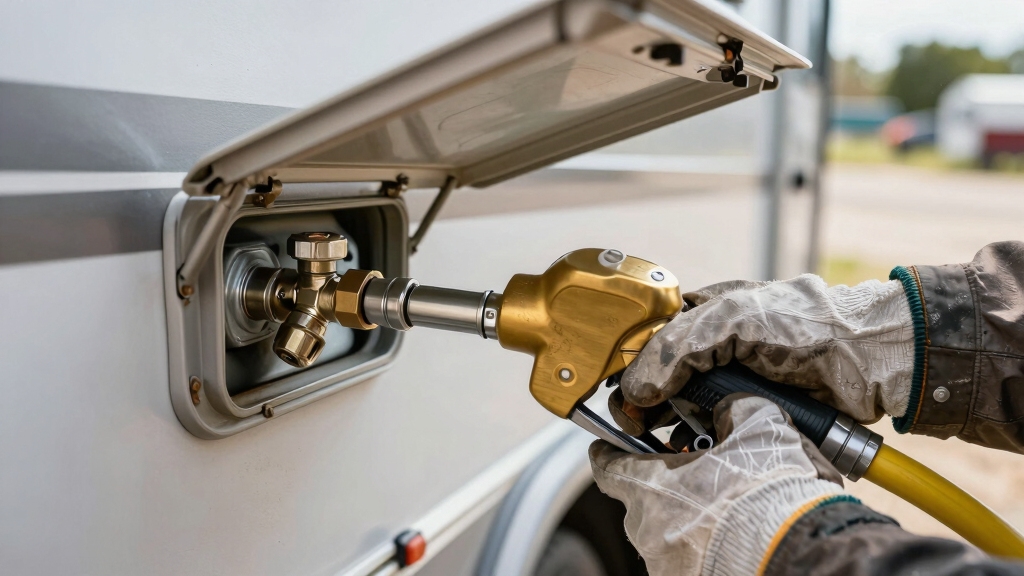
The certified attendant will remove the yellow lid on the fill valve and securely attach the hose to the fill port.
During filling, they’ll open the bleeder valve until liquid propane sprays, signaling the tank has reached 80% capacity.
This step guarantees safe expansion space inside the tank.
The process usually takes just a few minutes.
After filling, the attendant will close the bleeder valve, detach the hose, and reinstall any covers.
You can then securely reconnect your tanks to the RV, ready for use.
For optimal safety and performance, always ensure your propane tank connections are properly sealed and checked for weather resistance before use.
Safety Tips for Refilling RV Propane Tanks
Always prioritize safety by entrusting your RV propane tank refilling to certified professionals who understand the precise handling and procedures required. Never attempt to refill the tank yourself, as improper handling can lead to leaks or explosions.
Be certain the tank is disconnected from your RV before refilling and avoid carrying tanks by hand over long distances. Confirm the attendant follows proper protocols: unscrewing the fill valve cover, attaching the hose correctly, and opening the bleeder valve to release excess pressure until liquid appears.
Tanks must never be filled beyond 80% capacity to allow for propane expansion. Check that tanks are cool to the touch before filling, as heat increases pressure risk. Always comply with state transport weight limits for DOT tanks.
Prioritize these safety measures to protect yourself and your RV. Additionally, using propane tanks with built-in automatic shutdown systems can provide an extra layer of safety during refilling and use.
Checking and Monitoring RV Propane Levels
Regularly checking your RV propane levels helps prevent unexpected shortages and guarantees safe operation.
You should install a reliable fuel gauge on your tank to monitor propane levels accurately. If your tank lacks a gauge, lifting it gives a rough weight estimate; lighter tanks indicate lower propane.
Always check before trips and refill as needed to avoid running out mid-journey. Be cautious when handling tanks; never rely solely on visual inspection.
Remember that tanks fill only to 80% capacity to allow for propane expansion. Monitor the regulator’s function to maintain proper pressure for appliances.
Staying vigilant with these checks guarantees safe, uninterrupted propane use, protecting both your equipment and your safety while on the road.
For optimal accuracy and safety, consider using a propane gauge made from durable brass materials designed for outdoor conditions.
Frequently Asked Questions
Can I Refill My RV Propane Tank Myself at Home?
You shouldn’t refill your RV propane tank yourself at home.
Propane filling requires certified professionals and specialized equipment to guarantee safety and proper handling.
DIY refilling risks leaks, overfilling, and potential hazards like explosions or poisoning.
Always take your tank to a licensed station or propane supplier for refills.
This keeps you safe and complies with regulations.
Leave propane handling to experts trained in proper refilling procedures.
What Is the Difference Between DOT and ASME Propane Tanks?
You’ll find DOT tanks are portable, removable cylinders like the 20-pound grill tanks, designed for external use and transport.
ASME tanks, on the other hand, are stationary and larger, often permanently mounted on motorhomes, holding much more propane.
DOT tanks must be filled to 80% capacity for safety during expansion.
ASME tanks follow stricter regulations for stationary use.
Always handle both with care and follow safety guidelines.
How Much Does a Full 56-Pound Propane Tank Weigh?
A full 56-pound propane tank weighs about 80 pounds. That’s because propane weighs roughly 4.2 pounds per gallon.
These tanks hold around 21 gallons at 80% capacity for safety. So, when you add the tank’s empty weight plus the propane, you get that total.
Always handle tanks cautiously. Knowing the weight helps you avoid lifting injuries and ensures you comply with transport regulations.
Why Are Propane Tanks Only Filled to 80% Capacity?
Propane tanks are only filled to 80% capacity to allow room for liquid expansion.
When propane warms up, it expands, increasing pressure inside the tank. If you fill it completely, the pressure could become dangerously high, risking leaks or tank damage.
This 20% vapor space acts as a safety buffer, preventing overpressure.
Always make certain certified professionals handle filling so this critical safety measure is correctly followed for your protection.
How Do Regulators Affect Propane Appliance Performance?
Regulators control propane pressure, ensuring your appliances receive a steady, safe flow.
Without proper regulation, high pressure can damage equipment or cause inefficient combustion.
You’ll notice improved performance and safety when the regulator lowers tank pressure to a usable level.
Always check your regulator’s condition and replace it if faulty, as a malfunctioning regulator can disrupt appliance operation or pose serious hazards.
Don’t skip regular inspections for reliable propane use.
Smart Propane Refilling Habits Every RV Owner Should Follow
Filling your RV propane tank demands both care and confidence. While the process feels straightforward, overlooking safety can lead to serious risks.
You’ll want to prepare properly, choose trusted refill locations, and follow each step meticulously. Balancing caution with action guarantees your tank fills efficiently and safely.
Remember, vigilance before, during, and after refilling isn’t just smart—it’s essential. Don’t rush; respect the power you’re handling every time you fill up.