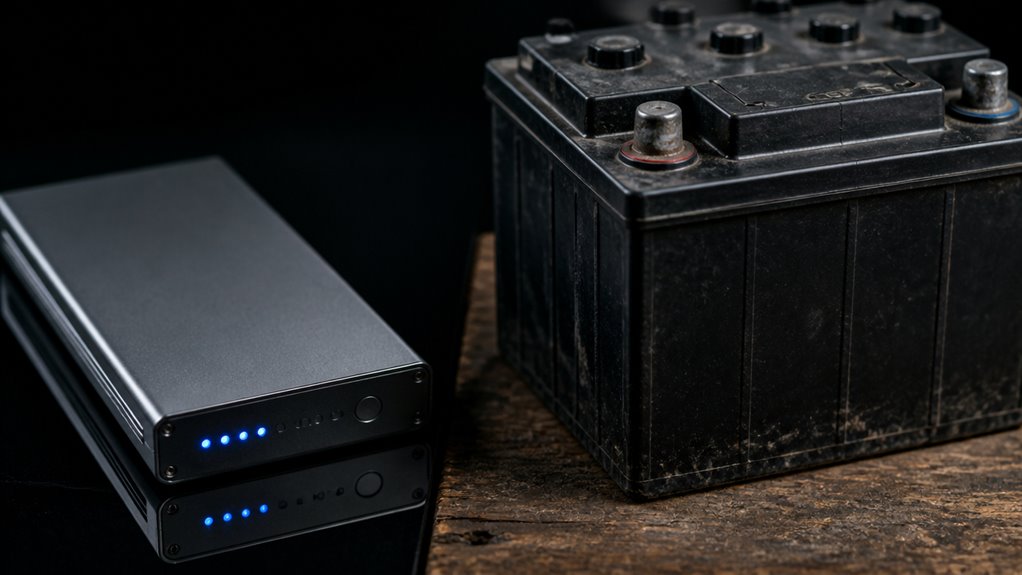
When comparing lithium-ion batteries to lead-acid deep cycle types, you gain faster charging, up to 5× quicker.
They also have longer lifespans, reaching 8–15 years, and offer 2–3 times greater usable capacity with 80–100% depth of discharge.
Lithium-ion units are lighter and more compact, easing installation and portability.
Although upfront costs are higher, their extended cycle life lowers cost per cycle.
Their benefits make them ideal for RV, marine, and solar use, with more performance details available as you explore further.

- 【Superior Performance】: Lithium iron phosphate battery has high energy density, Long cycle life…
- 【Long Cycle Times】: Lithium batteries 2000 + cycles no problem while the traditional lead-acid…
- 【Widely Uses】: Widely uses in most areas such as: Lighting (LED strip etc), Scooters, 12V…

- Renogy AGM Batteries: Trusted Worldwide, Exceptional Safety, Extreme Performance! Support series (No…
- Leading AGM Batteries: Renogy Deep Cycle AGM batteries have earned widespread trust with over…
- Exceptionally Safe Chemistry & Minimal Troubleshooting: Compared to batteries made of other…

Key Takeaways
- Lithium-ion batteries offer 2–3 times more usable capacity and deeper discharge (80–100% DoD) than lead-acid deep cycle batteries (30–50% DoD).
- Lithium-ion batteries weigh 2–3 times less and are more compact, simplifying installation and enhancing portability compared to bulky lead-acid deep cycle batteries.
- Lithium-ion batteries recharge up to 5 times faster, reducing downtime significantly compared to slower, multi-stage charging required for lead-acid deep cycle batteries.
- Lithium-ion batteries typically last 8–15 years with 3,000–5,000 cycles, far exceeding the 3–5 years and 500–1,000 cycles typical of lead-acid deep cycle batteries.
- Lithium-ion batteries feature built-in Battery Management Systems (BMS) that improve safety, reduce maintenance, and optimize charging, unlike lead-acid batteries requiring routine upkeep.
Lithium Ion Battery vs Deep Cycle: Key Differences in Lifespan, Charging, Capacity, and Performance
| Comparison Factors | Lithium-Ion Battery (Typical LiFePO4) | Lead-Acid Deep-Cycle Battery |
|---|---|---|
| Battery Chemistry | Lithium iron phosphate, a lithium-ion chemistry | Lead plates and sulfuric acid electrolyte |
| Primary Advantage | Higher usable energy and longer cycle life | Lower initial acquisition cost |
| Energy Density | Higher energy density | Lower energy density |
| Usable Capacity | Often 80–90% of nominal capacity | Often planned around 50% of nominal capacity |
| Depth of Discharge | Typically supports deeper cycling | Deeper cycling generally reduces cycle life |
| Cycle Life | Often thousands of cycles | Typically hundreds to around 1,000 cycles, depending on design and use |
| Service Life | Can provide longer service life with proper management | Generally shorter under frequent deep cycling |
| Charging Speed | Often supports higher charging current | Generally requires more conservative charging |
| Charging Efficiency | Typically higher round-trip efficiency | Typically lower round-trip efficiency |
| Battery Weight | Lighter for comparable usable capacity | Heavier for comparable usable capacity |
| Physical Size | Generally more compact | Generally larger and bulkier |
| Maintenance | Typically minimal routine maintenance | Flooded types require electrolyte maintenance; AGM and gel are lower-maintenance |
| Cold-Weather Charging | Charging may be restricted below freezing | Can charge in cold conditions within manufacturer limits, often at reduced rates |
| Battery Management | Commonly includes a Battery Management System (BMS) | Requires appropriate charging and monitoring, with controls varying by system |
| Initial Cost | Generally higher | Generally lower |
| Long-Term Operating Cost | May offer lower cost per delivered kWh under frequent cycling | May be economical for infrequent use or limited budgets |
| Typical Applications | RV house batteries, marine systems, solar storage, off-grid power | RV systems, marine applications, backup power, solar storage |
How Lithium Ion Batteries Differ From Lead-Acid Deep Cycle Batteries?

While both lithium-ion and lead-acid deep cycle batteries serve to provide reliable energy storage, they differ fundamentally in chemistry, performance characteristics, and application suitability.
Lithium-ion and lead-acid deep cycle batteries differ fundamentally in chemistry, performance, and ideal applications.
Lithium-ion batteries use lithium-based compounds, delivering higher energy density and faster charge rates than lead-acid variants, which rely on lead plates and sulfuric acid electrolyte.
Lithium-ion’s chemistry enables deeper discharge—up to 80–100%—without damage, whereas lead-acid batteries function most effectively at 30–50% depth of discharge to avoid premature wear.
Additionally, lithium-ion batteries are markedly lighter and more compact for the same usable capacity, making them ideal for mobile or space-constrained applications like RVs and marine systems.
These technical distinctions influence your choice depending on whether you prioritize upfront cost or long-term efficiency and performance in your energy storage solution.
Many lithium-ion batteries also feature advanced Battery Management Systems (BMS) that enhance safety, longevity, and real-time monitoring capabilities compared to traditional lead-acid models.
Lifespan and Cycle Life of Lithium Ion vs Lead-Acid Deep Cycle Batteries
Understanding the lifespan and cycle life of lithium-ion versus lead-acid deep cycle batteries helps you evaluate their long-term value and reliability.
Lithium-ion batteries typically last 8–15 years, with cycle counts between 3,000 and 5,000, often exceeding 7,000 in specialized models. Lead-acid deep cycle batteries usually endure 3–5 years with 500–1,000 cycles.
This stark difference means lithium-ion batteries require fewer replacements, reducing lifecycle costs despite higher upfront prices.
Many lithium iron phosphate (LiFePO4) batteries also feature an integrated Battery Management System that enhances safety and extends cycle life.
| Battery Type | Lifespan (Years) | Typical Cycle Life (Cycles) |
|---|---|---|
| Lithium-Ion Standard | 8–15 | 3,000–5,000 |
| Lithium-Ion Marine | Up to 20 | Up to 7,000 |
| Lead-Acid Flooded | 3–5 | 500–800 |
| AGM Lead-Acid | 3–5 | 600–1,000 |
| Gel Lead-Acid | 3–5 | 700–1,000 |
You’ll find lithium-ion batteries outperform deep cycle lead-acid types markedly in lifecycle durability.
Usable Capacity and Depth of Discharge Compared
When you look at lithium-ion batteries, you’ll notice they provide two to three times more usable capacity compared to lead-acid deep cycle batteries of the same size. That’s pretty impressive, right?
One of the key reasons for this is that lithium-ion cells can handle depths of discharge between 80% and 100% without really degrading. On the flip side, lead-acid batteries tend to work best when you keep them within a 30% to 50% depth of discharge.
So, why does this matter? Well, understanding these limits is crucial. The deeper you discharge a battery, the more it can affect its overall lifespan and the efficiency of your system.
Keeping these factors in mind can really help you make better choices for your energy needs. Additionally, the built-in Battery Monitoring System in lithium batteries helps prevent overcharging and excessive discharging, further protecting the battery life.
Usable Capacity Differences
When comparing usable capacity between lithium-ion and lead-acid deep cycle batteries, you’ll find that lithium-ion systems deliver substantially more effective energy storage for the same physical size.
Lithium-ion batteries typically provide two to three times the usable capacity of lead-acid counterparts due to their ability to sustain deeper discharge levels without compromising lifespan.
While lead-acid batteries perform at their best around 30–50% depth of discharge, lithium-ion units can safely utilize 80–100%, allowing you to access more energy per cycle.
This difference means that for equal rated capacity, lithium-ion batteries give you greater usable energy, making them more efficient for applications requiring frequent and deep cycling.
Consequently, lithium-ion’s higher usable capacity translates into improved system performance and reduced battery bank size, optimizing space and weight constraints.
Additionally, the built-in Battery Management System (BMS) in lithium-ion batteries ensures safety and longevity by protecting against overcharge, over-discharge, and thermal issues.
Depth Of Discharge Limits
Although both lithium-ion and lead-acid deep cycle batteries store energy, their depth of discharge (DoD) limits differ markedly. This impacts how much capacity you can reliably use.
You can discharge lithium-ion batteries to 80–100% DoD without significant degradation. This reveals a higher usable capacity relative to their rated size.
In contrast, lead-acid deep cycle batteries perform best when limited to 30–50% DoD. This helps avoid accelerated wear and capacity loss.
This means you effectively access less than half their nominal capacity without risking damage. Consequently, lithium-ion batteries offer two to three times more usable energy per cycle.
This enables deeper cycling and more efficient energy utilization. Understanding these DoD constraints helps you select the right battery for applications demanding consistent, high-capacity output.
Additionally, many lithium-ion batteries feature a built-in Battery Management System that protects against over-discharge, further enhancing their durability and safety.
Impact On Battery Life
Because usable capacity and depth of discharge directly influence cycle count and battery degradation, understanding their impact on battery life is essential.
When you use lithium-ion batteries, you benefit from a higher usable capacity, typically two to three times that of lead-acid deep cycle batteries.
They also have a depth of discharge (DoD) up to 80–100% without significant damage. In contrast, lead-acid batteries perform best when limited to 30–50% DoD to preserve cycle life, which reduces usable energy per cycle.
Consider these points for battery longevity:
- Higher DoD tolerance in lithium-ion means more energy use per cycle with less degradation.
- Lower DoD in lead-acid restricts usable capacity but extends battery life.
- Cycle count correlates inversely with DoD depth; deeper discharges accelerate wear.
Choosing lithium-ion maximizes usable capacity and cycle life efficiency. Additionally, the built-in Battery Management System in lithium batteries helps maintain optimal performance and safety over time.
Weight and Size Advantages of Lithium Ion Batteries
Boasting a weight two to three times lighter than lead-acid deep cycle batteries, lithium-ion technology markedly enhances portability and installation ease.
You’ll find lithium-ion batteries substantially reduce the physical burden during transport and setup, especially in applications like RVs, marine vessels, and off-grid systems.
Their compact size delivers higher energy density, allowing you to occupy less space while accessing two to three times more usable capacity compared to similarly sized lead-acid batteries.
This downsizing doesn’t compromise performance; instead, it optimizes system integration and spatial efficiency.
Consequently, you can design lighter, more streamlined power systems without sacrificing output.
In contrast, lead-acid batteries tend to be bulkier and heavier due to their chemical composition and construction, limiting flexibility and increasing installation complexity.
Additionally, lithium-ion batteries often feature built-in Battery Management Systems that protect against overcharge and discharge, enhancing safety and reliability.
Charging Speed and Maintenance for Lithium Ion vs Lead-Acid Batteries
You’ll notice that lithium-ion batteries recharge up to five times faster than lead-acid deep cycle types. This really helps cut down on downtime, which is a major plus.
Plus, when it comes to maintenance, lithium-ion batteries barely need any upkeep at all. This is a stark contrast to the frequent attention that flooded lead-acid batteries require.
Additionally, lithium-ion batteries can last up to 20 years, significantly outliving traditional deep cycle lead acid options.
Charging Time Comparison
Charging lithium-ion batteries takes markedly less time compared to lead-acid deep cycle batteries, often up to five times faster. This faster charging capability materially reduces system downtime, especially in solar, marine, and backup power setups.
You’ll notice that lithium-ion’s advanced chemistry allows higher charge currents without damaging the battery. In contrast, lead-acid types require slower charging to prevent sulfation and overheating.
Consider these points when comparing charging times:
- Lithium-ion batteries can recharge from 0% to 80% in under an hour, while lead-acid batteries may take 4–6 hours for the same state of charge.
- Lead-acid batteries need controlled, multi-stage charging to protect battery health, extending overall charge duration.
- Faster lithium-ion charging maximizes uptime and efficiency in demanding applications.
Additionally, lithium iron phosphate batteries feature rapid charging capabilities that make them especially suitable for off-grid and RV use.
Understanding these differences helps you choose the best battery type for your specific charging speed needs.
Maintenance Requirements
Beyond faster recharge times, maintenance demands differ markedly between lithium-ion and lead-acid deep cycle batteries.
Lithium-ion batteries require minimal upkeep: no watering, equalizing, or terminal cleaning due to their sealed design and stable chemistry.
In contrast, lead-acid batteries, especially flooded types, need routine checks and maintenance to prevent sulfation and electrolyte imbalance.
Faster charging of lithium-ion reduces downtime, enhancing operational efficiency in critical applications.
Lithium-ion batteries also benefit from built-in Battery Management Systems that protect against overcharging and short circuits, improving safety and longevity.
| Aspect | Lithium-Ion | Lead-Acid Deep Cycle |
|---|---|---|
| Charging Speed | Up to 5× faster | Slower, hours longer |
| Routine Maintenance | Minimal to none | Frequent (watering, cleaning) |
| Lifespan Impact | Less affected by fast charge | Risk of sulfation, degradation |
| Operational Downtime | Reduced | Increased due to maintenance |
Upfront Cost and Long-Term Value of Each Battery Type
While lithium-ion batteries command a substantially higher upfront price compared to lead-acid deep cycle options, their extended lifespan and reduced replacement frequency often deliver superior long-term value.
When you invest, consider that lithium-ion batteries can cost up to five times more initially but last 8–15 years with thousands of cycles. In contrast, lead-acid batteries typically last 3–5 years with fewer cycles, requiring more frequent replacements.
Key factors to assess include:
- Initial cost vs. longevity: Higher upfront cost offsets fewer replacements.
- Maintenance expenses: Lithium-ion requires minimal upkeep, reducing ongoing costs.
- Energy efficiency: Lithium-ion’s deeper discharge capacity increases usable energy, enhancing value.
You’ll find lithium-ion batteries offer better total cost efficiency in applications demanding frequent deep cycling and long service life.
Calculating Cost Per Cycle for Lithium Ion and Lead-Acid Batteries
Let’s kick things off by comparing the upfront costs of lithium-ion and lead-acid batteries. This gives us a clear picture of the initial investment differences right from the start.
Once we’ve those costs in mind, we need to think about cycle life. How many charge-discharge cycles can each battery handle before it needs to be replaced? This is where things get interesting.
Upfront Cost Comparison
Calculating the upfront cost per cycle for lithium-ion and lead-acid batteries helps you understand their true economic value over time.
Lithium-ion batteries demand a higher initial investment, often two to five times the price of comparable lead-acid units. However, this upfront cost must be analyzed alongside usable capacity and cycle count to assess cost efficiency accurately.
Consider these key points for your evaluation:
- Initial price ranges: Lead-acid (flooded $100–$200; AGM/gel $200–$450) vs. lithium-ion ($500–$1,000+)
- Usable capacity: Lithium-ion offers 2–3 times more usable energy per charge cycle.
- Cycle life: Lithium-ion supports thousands of cycles, markedly extending battery life and delaying replacement costs.
This comparison helps you balance upfront commitment against long-term value from investment.
Cycle Life Impact
Understanding the cycle life impact lets you accurately gauge the true cost effectiveness of lithium-ion versus lead-acid deep cycle batteries.
Lithium-ion batteries deliver 3,000 to 7,000 cycles over 10–20 years, whereas lead-acid batteries typically provide 500 to 1,000 cycles over 3–5 years.
To calculate cost per cycle, divide the upfront cost by the total cycle count.
For example, a $1,000 lithium-ion battery with 5,000 cycles costs $0.20 per cycle, while a $300 lead-acid battery with 700 cycles costs approximately $0.43 per cycle.
This calculation reveals lithium-ion’s superior value despite higher initial investment, driven by its extended lifespan and cycle durability.
Factoring in usable capacity and depth of discharge further favors lithium-ion, reducing your effective cost per usable cycle.
Performance in RV, Marine, and Solar Applications
Frequently, lithium-ion batteries outperform traditional deep cycle lead-acid batteries in RV, marine, and solar applications due to their higher usable capacity, faster charging rates, and longer cycle life.
When you rely on lithium-ion, you get deeper discharges without damaging the battery, which means more usable energy for your devices or systems.
Plus, their rapid recharge capabilities minimize downtime, vital for solar setups or marine use where power availability fluctuates.
Their extended lifespan reduces replacement frequency, improving overall system reliability.
Key advantages you’ll notice include:
- Higher usable capacity lets you use up to 80–100% of stored energy versus 30–50% for lead-acid.
- Faster charging supports quick energy replenishment during sunlight or engine run time.
- Longer cycle life means fewer replacements and lower long-term costs.
Installation and Portability Factors for Lithium Ion and Lead-Acid Batteries
Beyond performance metrics like capacity and cycle life, installation and portability play a significant role in battery selection for RV, marine, and solar systems.
Lithium-ion batteries weigh two to three times less and occupy less space than lead-acid deep cycle batteries, simplifying mounting and transportation. This weight reduction eases system integration and enhances mobility.
Conversely, lead-acid batteries are bulkier and demand sturdier supports due to their mass.
| Factor | Lithium-Ion | Lead-Acid Deep Cycle |
|---|---|---|
| Weight | Lightweight (2-3x lighter) | Heavy and bulky |
| Size | Compact, space-efficient | Larger footprint |
| Installation Ease | Easier, less structural support | Requires reinforced mounts |
Lithium-ion batteries enable quicker, less labor-intensive installs and improve portability for mobile setups.
Choosing Lithium Ion vs Lead-Acid Deep Cycle Batteries
When choosing between lithium-ion and lead-acid deep cycle batteries, you need to weigh upfront costs against long-term performance and maintenance demands.
Lithium-ion batteries offer superior cycle life, higher usable capacity, and minimal upkeep, but come with a markedly higher initial price.
Lead-acid deep cycle batteries have lower upfront costs, but shorter lifespans and require regular maintenance.
Consider these factors when deciding:
- Cycle life & lifespan: Lithium-ion lasts 3–5 times longer with up to 5,000 cycles. Lead-acid averages 500–1,000 cycles.
- Depth of discharge & capacity: Lithium-ion supports 80–100% discharge, yielding more usable energy per cycle.
- Maintenance & charging: Lithium-ion charges faster and demands less maintenance, reducing downtime and labor.
Your choice hinges on balancing budget constraints with system longevity and operational efficiency.
Frequently Asked Questions
Are Lithium-Ion Batteries Recyclable and Environmentally Friendly?
Yes, lithium-ion batteries are recyclable, but the process can be complex due to their chemical composition.
You’ll find specialized facilities that recover valuable metals like lithium, cobalt, and nickel, reducing environmental impact.
While they’re more environmentally friendly than many alternatives because of longer lifespans and higher efficiency, improper disposal can cause pollution.
You should always recycle them through certified programs to minimize ecological harm and recover critical materials sustainably.
How Do Temperature Extremes Affect Lithium-Ion and Lead-Acid Batteries?
Temperature extremes impact your lithium-ion batteries by reducing capacity and cycle life, especially below freezing and above 45°C. High heat accelerates degradation, while extreme cold limits discharge performance.
Lead-acid batteries suffer more in cold, losing up to 50% capacity near freezing. Heat speeds electrolyte evaporation, damaging cells.
You’ll find lead-acid batteries generally tolerate moderate temperatures but require careful management to avoid permanent damage in extremes.
Can Lithium-Ion Batteries Be Safely Used in Cold Weather Conditions?
You can safely use lithium-ion batteries in cold weather, but their performance drops below freezing.
For example, capacity can decrease by up to 20% at 0°C (32°F).
Charging below 0°C risks lithium plating, which damages the battery.
To protect your battery, you’ll want a built-in thermal management system or external heating.
Monitoring temperature closely guarantees peak operation and longevity in cold environments.
What Safety Precautions Are Needed When Handling Lithium-Ion Batteries?
You should always avoid physical damage or puncturing lithium-ion batteries, as this can cause thermal runaway.
Keep them away from extreme temperatures and moisture, and never short-circuit the terminals.
Use proper chargers designed for lithium-ion chemistry to prevent overcharging or overheating.
Store batteries in a cool, dry place and monitor for swelling or leakage.
Always follow manufacturer guidelines for handling, transportation, and disposal to guarantee safety and maintain performance.
How Do Warranty Terms Compare Between Lithium-Ion and Lead-Acid Batteries?
You’ll find lithium-ion batteries generally come with longer, more all-encompassing warranties, often covering 8 to 10 years or 3,000+ cycles. This reflects their extended lifespan and reliability.
Lead-acid batteries typically offer shorter warranties, around 1 to 3 years, due to their limited cycle life and maintenance needs.
When comparing, consider that lithium-ion warranties usually cover capacity retention and performance. Lead-acid warranties focus more on manufacturing defects and early failures.
Choose the Best Battery for Long-Term Energy Storage
When choosing between lithium ion and lead-acid deep cycle batteries, consider that lithium ion batteries often deliver over 2,000 cycles at 80% depth of discharge. This is double that of lead-acid alternatives.
This dramatically enhances lifespan and cost-efficiency despite higher upfront costs. Their superior energy density, faster charging, and lighter weight make them ideal for demanding RV, marine, and solar use.
Ultimately, your decision hinges on balancing performance needs with budget and installation constraints.
- 【Superior Performance】: Lithium iron phosphate battery has high energy density, Long cycle life…
- 【Long Cycle Times】: Lithium batteries 2000 + cycles no problem while the traditional lead-acid…
- 【Widely Uses】: Widely uses in most areas such as: Lighting (LED strip etc), Scooters, 12V…
- Renogy AGM Batteries: Trusted Worldwide, Exceptional Safety, Extreme Performance! Support series (No…
- Leading AGM Batteries: Renogy Deep Cycle AGM batteries have earned widespread trust with over…
- Exceptionally Safe Chemistry & Minimal Troubleshooting: Compared to batteries made of other…
Last update on 2026-11-25 / Affiliate links / Images from Amazon Product Advertising API