When choosing between 30-amp and 50-amp RV service, consider your power needs and appliance load. A 30-amp supplies up to 3,600 watts via one hot leg, suitable for smaller RVs with basic appliances.
A 50-amp delivers 12,000 watts through dual hot legs, supporting multiple high-demand devices and luxury amenities.
Using adapters allows connection but won’t increase capacity. Proper load management and plug compatibility are vital to avoid overloads.
Explore deeper to optimize your RV’s electrical setup and safety.
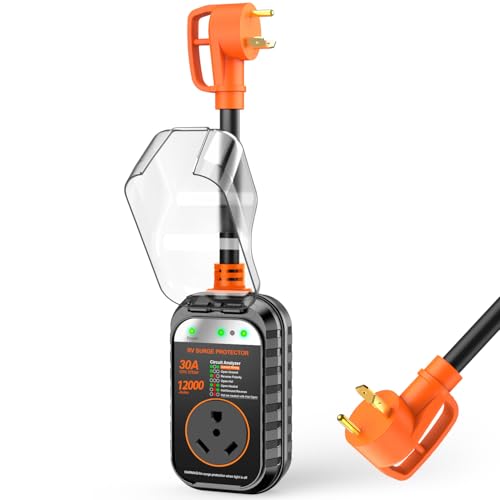
- Portable RV Surge Protectors: GEARGO RV Surge Protectors are designed to identifies faulty power and…
- Circuit Analyzer: This allows you to test the quality of your power before connecting your RV, by…
- Safety Protection: FCC tested. V-1 flame-retardant materials and IP68 waterproof design make it…

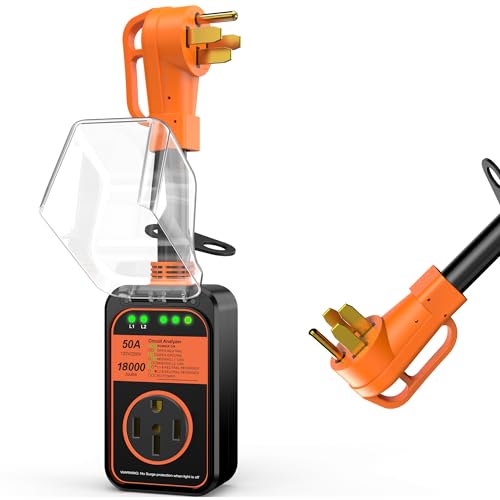
- 𝟐𝟎𝟐𝟔 𝐍𝐞𝐰 𝐔𝐩𝐠𝐫𝐚𝐝𝐞𝐝 RV Surge Protector: This 50 Amp surge…
- Simple Plug and Play Solution: This 50A RV surge protector features a user-friendly design. Simple…
- Safety Protection: The RV surge protector 50 Amp is equipped with flame-retardant materials and…
Key Takeaways
- 30-amp service provides a single 120-volt hot leg delivering up to 3,600 watts, suitable for smaller RVs with modest power needs.
- 50-amp service supplies two 120-volt hot legs combining for 12,000 watts total, ideal for RVs with multiple high-demand appliances.
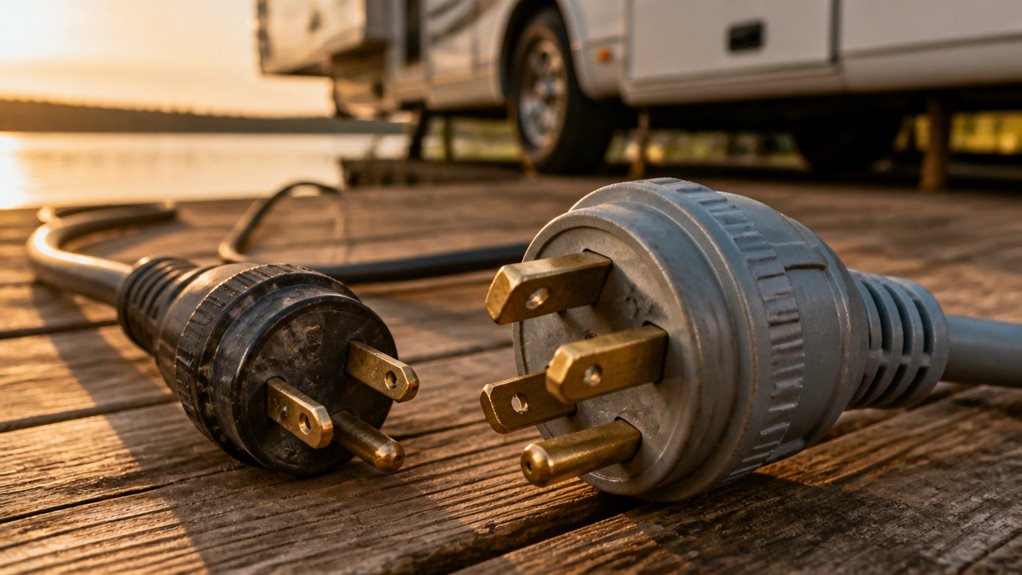
- 30-amp uses a three-prong plug while 50-amp requires a four-prong plug for proper connection and power distribution.
- Using adapters allows a 30-amp RV to connect to a 50-amp pedestal but limits power usage to 30 amps.
- 50-amp service reduces breaker trips and supports luxury amenities, while 30-amp requires careful load management to avoid overloads.
30 Amp vs 50 Amp for RV: Key Differences in Power, Wiring, and Electrical Hookups
| Comparison Factors | 30 Amp RV Service | 50 Amp RV Service |
|---|---|---|
| Electrical Configuration | Single 120V hot leg | Two 120V hot legs |
| Maximum Current | 30 amps | 50 amps per hot leg |
| Nominal Voltage | 120 volts | 120/240-volt split-phase supply |
| Maximum Available Power | 3,600 watts | 12,000 watts combined |
| Plug Configuration | 3-prong TT-30 plug | 4-prong 14-50 plug |
| Hot Wires | One hot wire | Two hot wires |
| Neutral and Ground | One neutral and one ground | One neutral and one ground |
| Typical RV Applications | Smaller travel trailers and motorhomes | Larger RVs, fifth wheels, and motorhomes |
| Air Conditioner Support | Often supports one RV air conditioner, depending on load | Can support multiple air conditioners, depending on system design |
| Simultaneous Appliance Use | More limited with high-wattage appliances | Greater flexibility for high electrical loads |
| Electrical Load Management | Requires careful coordination of appliances | Still requires proper load distribution |
| Campground Hookups | Requires a compatible 30A connection or approved adapter | Requires a compatible 50A connection for full capacity |
| Adapter Compatibility | Can connect to a 50A pedestal using a suitable adapter | Can connect to a 30A pedestal using a suitable adapter |
| Adapter Power Limitation | Remains limited by the RV’s 30A electrical system | Limited to 30A supply capacity when using a 30A hookup |
| Generator Requirements | Generator capacity must support actual appliance demand | Larger loads may require greater generator capacity |
| Electrical Installation | Simpler single-hot-leg configuration | More involved dual-hot-leg configuration |
| Primary Advantage | Suitable for modest RV electrical demands | Higher overall power capacity |
| Overall Recommendation | Best for RVs designed around 30A service | Best for RVs designed around 50A service |
30 Amp vs 50 Amp RV Service: Key Differences Explained

While both 30-amp and 50-amp RV services supply power to your recreational vehicle, they differ markedly in capacity and configuration.
30-amp and 50-amp RV services both provide power but vary significantly in capacity and setup.
A 30-amp service delivers up to 3,600 watts on a single 120-volt hot leg, limiting simultaneous appliance use.
In contrast, 50-amp service provides two 120-volt hot legs, combining for 12,000 watts total, roughly three times the power capacity.
This configuration supports higher electrical loads without overloading the system.
The 30-amp setup uses a three-prong plug, while 50-amp employs a four-prong plug to manage the dual hot legs, neutral, and ground.
Understanding these differences lets you assess your RV’s electrical demands accurately.
This ensures you select a service that meets your power needs efficiently and safely.
To protect your RV appliances effectively, it is crucial to use an RV surge protector designed for your specific power rating.
How RV Size And Usage Affect Your Power Needs?
Understanding your RV’s size and typical usage directly influences the choice between 30-amp and 50-amp power service.
Smaller or older RVs generally require 30-amp service, as their electrical loads remain modest, often limited to basic lighting and small appliances.
Conversely, larger RVs, such as fifth wheels and motorhomes, demand 50-amp service to supply up to 12,000 watts. This supports multiple high-draw devices simultaneously.
Your travel style also matters. Extended stays and comfort-focused setups favor 50-amp systems for greater electrical flexibility and load management.
Selecting the appropriate service guarantees your RV’s power system matches its design load. This prevents breaker trips and optimizes energy distribution.
Therefore, precise evaluation of RV size and intended electrical usage is critical for determining whether 30-amp or 50-amp service best meets your power needs.
When connecting a 30-amp RV to a 50-amp power source, using a proper 30A to 50A adapter ensures safe and reliable power delivery without overloading circuits.
Which Appliances Work Best On 30 Amp And 50 Amp RV Service?
When it comes to RV appliances, understanding the difference between 30-amp and 50-amp service is super important.
With 30-amp service, you can power common appliances like standard refrigerators and small microwaves without a hitch. They usually run efficiently within a 3,600-watt limit.
On the flip side, if you have 50-amp service, you’ve got a lot more power at your fingertips. This setup can handle high-demand devices like multiple air conditioners and electric ovens, offering up to 12,000 watts across two hot legs. Pretty impressive, right?
Just remember, whether you’re on 30-amp or 50-amp service, managing your appliance load is key. You definitely want to avoid circuit overload, especially when you’re using 30-amp service. So, plan ahead to keep everything running smoothly!
For optimal RV comfort, consider using a screen tent to create a bug-free, shaded outdoor space.
Common 30-Amp Appliances
Electrical appliances in a 30-amp RV must operate within a 3,600-watt limit. This influences which devices you can run simultaneously.
Typically, you’ll rely on low-to-moderate wattage appliances like LED lighting, small microwaves, compact refrigerators, and water pumps. These devices generally consume between 100 and 1,200 watts, allowing you to manage loads without tripping breakers.
You can run a single air conditioner but must avoid operating multiple high-draw appliances concurrently. Electric kettles, coffee makers, and small TVs fit well within this capacity.
You’ll need to monitor total wattage actively, prioritizing essential devices and staggering usage to prevent overload. This constraint demands disciplined load management, as exceeding 3,600 watts risks breaker trips and appliance shutdowns.
This limitation can affect comfort and convenience during your RV travels. Choosing durable and compatible components, such as RV electrical fittings, can help maintain safe and efficient power distribution.
High-Demand 50-Amp Devices
Many high-demand appliances require the increased capacity of a 50-amp RV service to operate efficiently without risking circuit overload.
With two 120-volt legs delivering up to 12,000 watts, 50-amp service supports devices like dual air conditioners, electric ovens, and large refrigerators simultaneously.
These appliances draw significant current, often exceeding the 3,600-watt limit of a 30-amp system.
When you rely on 50-amp service, you reduce the risk of frequent breaker trips caused by high cumulative loads.
Additionally, the dual-leg configuration balances power distribution, allowing continuous operation of multiple high-wattage devices.
If your RV includes luxury amenities or you plan extended stays requiring heavy appliance use, 50-amp service is necessary to maintain peak performance and safety without compromising system integrity or convenience.
To ensure safe and efficient operation, pairing a 50-amp service with a pure sine wave inverter is recommended, as it provides stable, clean power suitable for sensitive electronics.
Managing Appliance Load
When balancing appliance load in your RV, understanding the power limits of 30-amp and 50-amp systems is essential to prevent overloads and guarantee efficient operation.
A 30-amp service delivers up to 3,600 watts on a single hot leg, limiting simultaneous use of high-draw appliances like air conditioners and electric ovens.
You’ll need to prioritize essential devices and avoid running multiple heavy loads together.
In contrast, a 50-amp service provides up to 12,000 watts across two hot legs, allowing you to run multiple high-demand appliances simultaneously with less risk of tripping breakers.
However, you must manage load distribution between the two legs to maintain balance and avoid breaker trips.
Proper load management secures appliance efficiency and system safety regardless of your RV’s electrical service type.
Using an automatic transfer switch can further enhance safety by preventing power surges and ensuring smooth transitions between power sources.
Electrical Setup And Plug Differences Between 30 Amp And 50 Amp
Although both 30-amp and 50-amp RV services provide power to your vehicle, their plug designs and electrical setups differ substantially to accommodate their distinct capacities.
A 30-amp RV uses a three-prong, single hot leg design delivering 120 volts, capped at 3,600 watts. In contrast, a 50-amp RV employs a four-prong plug with two hot legs, a neutral, and a ground, effectively supplying 240 volts split into two 120-volt legs, allowing up to 12,000 watts.
This dual-leg setup requires balanced load distribution to optimize performance and prevent breaker trips. Physically, the plugs differ in pin configuration and size, preventing mismatches without adapters.
Understanding these distinctions makes certain you select the correct hookup and wiring compatible with your RV’s power demands, maintaining safety and operational efficiency.
Using a 50 Amp RV Surge Protector is highly recommended to protect your vehicle’s electrical system from voltage spikes and wiring faults.
Is It Safe To Use A 50 Amp RV On A 30 Amp Hookup?
Absolutely, you can use an adapter to connect your 50-amp RV to a 30-amp hookup. Just keep in mind that your power draw will be capped at 3,600 watts.
So, it’s really important to manage your appliance load carefully. You don’t want to trip any breakers or risk overheating. Without taking the right precautions, you could end up with some electrical hazards if you overload that 30-amp circuit.
Just play it safe, and make sure you’re aware of what you’re running! Using an RV battery monitor with alarm and notifications can help you avoid overloads and maintain safe power usage.
Adapter Use And Limits
Plugging a 50-amp RV into a 30-amp hookup requires careful consideration and proper adapters to guarantee safety and functionality.
You must recognize that a 30-amp supply limits your RV’s power to 3,600 watts, regardless of the RV’s 50-amp design. Using an adapter won’t increase capacity; it only enables physical connection.
To avoid electrical overload or damage, you need to manage load carefully.
Consider these key points:
- Use a 50-to-30 amp adapter rated for your RV’s plug type.
- Monitor total power draw to stay within the 30-amp limit.
- Avoid simultaneous use of high-wattage appliances.
- Inspect adapters regularly for wear or damage to prevent hazards.
Adapters facilitate connection but impose strict power limits you must respect. For optimal climate control during reduced power scenarios, consider installing an RV thermostat with programmable schedules to efficiently manage energy use.
Power Draw Management
Managing power draw effectively becomes critical when connecting a 50-amp RV to a 30-amp hookup. Your 50-amp RV demands up to 12,000 watts, but a 30-amp hookup supplies only 3,600 watts, limiting available power drastically.
You must prioritize essential appliances and avoid running multiple high-wattage devices simultaneously to prevent breaker trips.
| Appliance | Power Draw (Watts) |
|---|---|
| Air Conditioner | 1,500 – 2,000 |
| Electric Oven | 1,200 – 1,500 |
| Refrigerator | 100 – 800 |
| Miscellaneous Lights | 100 – 300 |
You should monitor your load carefully, using power meters if possible. Switch off non-essential devices to maintain safe operation within the 30-amp limit. This approach guarantees you avoid overloading the system despite the RV’s higher capacity design. Using a tire pressure monitoring system can help ensure your RV’s tires remain safe and properly inflated during these power management adjustments.
Safety Risks And Precautions
Although connecting a 50-amp RV to a 30-amp hookup can be done with proper adapters, it introduces significant safety risks if power draw isn’t carefully controlled.
The 30-amp service provides a maximum of 3,600 watts, far less than the 12,000 watts designed for 50-amp systems.
Overloading can cause breakers to trip or wiring to overheat, risking fire or damage.
To mitigate hazards, you need to:
- Monitor total load constantly to avoid exceeding 30 amps.
- Use a compatible adapter designed for safe connection.
- Limit simultaneous appliance use, especially high-draw units like ACs or ovens.
- Inspect wiring and connections regularly for signs of overheating or wear.
Careful management assures safety when adapting a 50-amp RV to a 30-amp source.
Key Factors To Consider When Choosing 30 Amp Or 50 Amp RV Service
Evaluating your RV’s electrical needs requires careful consideration of several key factors, including power capacity, appliance load, RV size, and typical usage patterns.
You’ll want a system that matches your RV’s electrical demands without risking overloads. A 30-amp service suits smaller RVs with limited appliances.
In contrast, 50-amp service fits larger rigs requiring multiple high-draw devices simultaneously.
Also, consider how often and how long you use your RV since longer trips favor higher capacity.
| Factor | 30 Amp | 50 Amp |
|---|---|---|
| Max Wattage | 3,600 W | 12,000 W |
| Hot Legs | 1 | 2 |
| RV Size Typical | Small/Older | Large/Fifth Wheel |
| Appliance Support | Limited simultaneous use | Supports multiple high-load |
Match your choice precisely to avoid inefficiency or electrical hazards.
Campground And Generator Compatibility With 30 Amp And 50 Amp RV Service
When selecting a campsite or planning generator use, understanding campground and generator compatibility with your RV’s electrical service is essential.
Campgrounds typically offer both 30-amp and 50-amp hookups, with 30-amp common in smaller sites. If you have a 30-amp RV, you can plug into a 50-amp pedestal using an adapter but will remain limited to 30 amps.
Conversely, a 50-amp RV connected to a 30-amp hookup requires careful load management to avoid overloads. Generator sizing must align with your RV’s amperage to assure sufficient power without risking damage.
- Confirm campground pedestal amperage matches or exceeds your RV’s service.
- Use proper adapters for cross-compatibility without exceeding amperage limits.
- Size generators to meet or surpass the RV’s maximum power draw.
- Monitor load carefully when using lower amperage hookups to prevent breaker trips.
Frequently Asked Questions
How Does Weather Affect the Performance of 30 Amp Vs 50 Amp RV Systems?
Weather affects your RV’s electrical performance mainly through temperature and moisture.
Cold weather can reduce battery efficiency and increase appliance demand, potentially stressing your system.
Moisture and humidity risk corrosion in connections, impacting reliability.
While both 30-amp and 50-amp systems face these challenges, your 50-amp setup’s higher capacity offers better resilience under increased load from heating or cooling devices during extreme weather conditions.
Can 30 Amp RVS Be Easily Upgraded to 50 Amp Service Later?
You can upgrade a 30-amp RV to 50-amp service, but it’s not always straightforward.
You’ll need to replace the electrical panel, wiring, and power inlet to handle the higher amperage safely.
This involves rewiring to accommodate two hot legs and possibly upgrading your breaker box.
Consult a qualified electrician to guarantee compliance with electrical codes and compatibility with your RV’s appliances and systems.
It’s a technical upgrade, not just a plug swap.
What Maintenance Is Required for 30 Amp and 50 Amp RV Electrical Systems?
You’ll need to regularly inspect breakers, wiring, and connectors for corrosion or damage.
Tighten all electrical connections to prevent arcing.
Clean and lubricate plugs and receptacles to guarantee proper contact.
Test GFCI outlets and circuit breakers periodically to verify functionality.
For 50-amp systems, balance loads across both legs to avoid overloads.
Always use a multimeter to check voltage and continuity.
Follow manufacturer guidelines for specific component maintenance.
Are There Insurance Differences for RVS With 30 Amp Vs 50 Amp Service?
Insurance differences between RVs with 30-amp and 50-amp service are minimal. Insurers focus more on vehicle value, size, and usage than electrical capacity.
While a 50-amp RV’s higher power capability supports more amenities, it doesn’t typically increase premiums directly. However, because 50-amp RVs tend to be larger and more valuable, you might see slightly higher rates.
Always disclose your RV’s specs accurately to ensure proper coverage.
How Do Solar Power Setups Integrate With 30 Amp and 50 Amp RV Systems?
Solar power setups integrate by charging your RV’s battery bank. This stored energy then powers your 12-volt system, regardless of your RV’s shore power amperage.
You’ll need an inverter to convert DC to AC for your 30-amp or 50-amp systems. For 50-amp RVs, larger inverter capacity and battery storage are necessary to meet higher loads.
In contrast, 30-amp setups require less power. Proper charge controllers and load management keep your system stable and efficient.
Choose the Right RV Hookup for Your Power Needs
Choosing between 30 amp and 50 amp RV service boils down to your rig’s size and power demands.
Think of it like fueling a car: a bigger engine needs more gas. If you rely on multiple high-wattage appliances, 50 amp is your best bet.
For smaller setups, 30 amp often suffices. Always match your electrical setup to your RV to guarantee safety, efficiency, and compatibility with campgrounds and generators.
Don’t overload; power wisely.
- Portable RV Surge Protectors: GEARGO RV Surge Protectors are designed to identifies faulty power and…
- Circuit Analyzer: This allows you to test the quality of your power before connecting your RV, by…
- Safety Protection: FCC tested. V-1 flame-retardant materials and IP68 waterproof design make it…
- 𝟐𝟎𝟐𝟔 𝐍𝐞𝐰 𝐔𝐩𝐠𝐫𝐚𝐝𝐞𝐝 RV Surge Protector: This 50 Amp surge…
- Simple Plug and Play Solution: This 50A RV surge protector features a user-friendly design. Simple…
- Safety Protection: The RV surge protector 50 Amp is equipped with flame-retardant materials and…
Last update on 2026-11-28 / Affiliate links / Images from Amazon Product Advertising API